


A new airborne scare. The threat of renewed kinetic conflict in Iran. The Strait of Hormuz still effectively closed, with the oil shock the closure has been promising starting to land in real prices and real supply chains. A.I. disrupting the workplace at a breakneck pace. Washington producing fresh chaos at a rate that has stopped surprising anyone.
The headlines are all new, and all the same.
That is the strange feature of the era we are inside. Every shock arrives wearing a fresh costume, with new technical vocabulary and new geographic specifics, and every one turns out to be a variation on a single underlying condition: an architecture of supports we grew up trusting that is no longer carrying the weight it used to. The pandemic. The supply chain. The bond market. The institutional erosion. The kinetic conflicts on three continents. None of these is a freestanding event. They are the era expressing itself in different keys.
I have been writing about this for years on The B:Side Way. I have been teaching it to my students at Arizona State. I have been making operating decisions inside B:Side Capital that have been shaped by it. And for the last two years, I have been working on a book about it. Honor Under Pressure is the first in a series, and it is reaching readers as the world makes clear how badly it is needed.
Something happened over those two years that I did not expect. What began as research for myself, work I was doing privately to figure out how I could actually lead through this, became a practice. An actual one. A set of moves I run on real decisions. A code I check myself against when the pressure rises. A way of operating that does not get washed away when the news cycle turns.
And what I realized, somewhere in the middle of the third draft of the book, was this: telling people about a framework is not the same as giving them a tool they can use. The shelf of leadership books is already long. Most of them get read once and live out their days as decoration. I wanted to write something useful enough to stay open.
Why a Framework Wasn’t Enough
A book can name the pattern. It can put words on what you already feel. It can hand you a vocabulary. But a book closes. The decisions do not close. The board meeting on Friday does not close. The conversation with the team member you have been avoiding does not close. The choice between two options that both cost something does not close.
If the framework only lives on the page, the framework only helps on the page.
That gap, between the page and the call, is where most leadership work fails right now. We have produced a remarkably literate generation of leaders. They read the right things. They use the right language. They can tell you what the pattern is, often in real time, often with footnotes. And then they get to a decision where the supports they grew up trusting are not carrying the weight, and they improvise. Most of the improvisations do not hold.
The Pattern Underneath
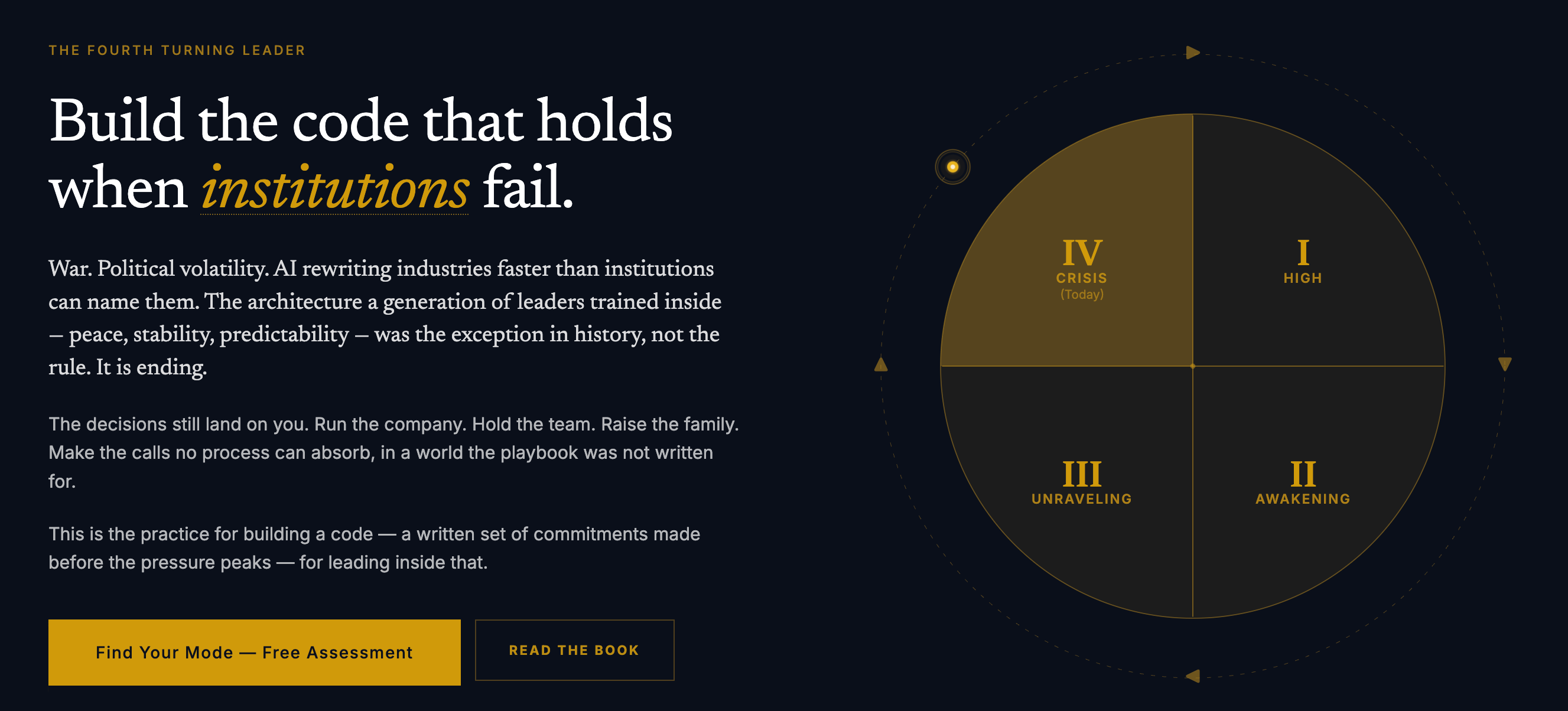
The historians William Strauss and Neil Howe gave us the language of the Fourth Turning. Every roughly eighty years, a society moves through four phases: a high, an awakening, an unraveling, and a crisis. The fourth phase is when the supports a generation of leaders grew up depending on start to fail at the same time. Institutional legitimacy. Settled consensus. Predictable incentives. Time to deliberate. They do not weaken one at a time. They weaken together.
We have lived through three of these as a country before. The Revolution. The Civil War. The Depression and the Second World War. Each one looked unprecedented from the inside. Each one produced leaders we still study because they built and held something when the architecture around them failed.
We are seventeen years into the current one. That is the math.
The reason the practice has to be built now, not after the dust settles, is that pressure does not negotiate with anything you have not already decided. It negotiates with everything you haven’t. If you are still trying to figure out your line in the moment you are being asked to cross it, you have already lost the argument with yourself. The decision is being made under conditions designed to corrupt it.
The leaders we admire from past crises did not invent their code in the moment. They had laid it down in advance, written or unwritten, and the crisis tested what was already there. Washington declined power when the war ended because he had decided he would, long before the temptation arrived. Lincoln let the moment remake his moral framework, in public, at cost, because he had already committed to keep growing into the call. Marshall built people and institutions that outlasted him because he had decided early that the standard mattered more than his name on it.
The Call You Cannot Outsource
The pressure is concrete. Inside an SBA lender like B:Side, it lands as decisions made on shrinking runways with thinning information, stakeholders who want certainty the world cannot honor, and markets that reward speed and punish reflection. In a classroom of business students who did everything the old map told them to do, it lands as the slow recognition that the math they were promised does not run anymore, and that they are going to have to lead inside a system rewriting its own rules in real time.
Both of those point at the same conclusion. Leadership in this era cannot be borrowed. It cannot be downloaded. It cannot be outsourced to a process. The decisions that matter most are the ones no policy and no consensus will catch you on. You stand on them, or you don’t.
What I Built
That is why I built The Fourth Turning Leader.
It lives at thefourthturningleader.com. It is the companion to the book, but it is built to do something the book cannot do on its own. It turns the framework into a practice. It moves you through the work of building a code, testing it against real decisions, and tracking whether the code actually held when you needed it to.
Here is what is inside it.
You start with the Mode Finder. It is a free assessment that takes about eight minutes. It is built around the five historical figures who anchor the book: Cato, Washington, Seneca, Lincoln, and Marshall. Each one represents a different mode of leading under pressure. Holding the line when the order around you bends. Restraining yourself when you have the power to take more. Staying inside a system you cannot fix without becoming the corruption. Letting a crisis remake your moral framework in public. Building people and standards that hold without you. The assessment names which mode your current moment is calling for, and which shadow is most likely to distort it.
From there you move into what I call the Leader Lab. The Lab is a sequence of working tools. There is nothing to finish. There is only practice to return to.
The Shadow Audit is the second tool. It surfaces the failure pattern your mode is most likely to produce before the pressure makes that pattern invisible to you. Every mode has its shadow. The leader who holds the line can become rigid. The leader who restrains can become passive. The leader who compromises can become complicit. The Audit puts those patterns in writing so you can see them coming.
The Honor Code Builder is the heart of it. It walks you through writing a five-part code: the Line you will not cross, the Restraint you will impose on yourself when you have leverage, the Midnight Test you use to check the call when you are tired and the stakes are high, the Growing Edge you commit to keep developing, and the Transmission of the standard to the people who will inherit it. The code is yours. It is private. It is written. And it is the thing pressure has to negotiate with.
The Decision Room is where the code gets tested. You bring one real call you are working. You name the pressure on it. You lay out the options. You make the commitment in writing, against the code you just built. You log it. And then you come back to it later to see what it cost and whether you held.
The Endurance Ledger is the long view. It tracks the calls over time. What the code cost you. What it taught you. Where it bent. Where it broke. Where it strengthened. This is the part that turns a framework into a practice you can trust.
The Transmission Plan is the final piece. It maps the people whose development is going to depend on your code holding when you are tested. Team members. Students. Successors. Family. The standard you set in the hardest moment is the standard they will inherit, whether you mean for them to or not. The Plan makes that responsibility visible.
There are also Pressure Drills, short weekly scenarios calibrated to your mode and your active shadow, designed to sharpen judgment in writing before the real call lands. And there is a Field Notes library: the books I actually return to when I am thinking through this, with notes on how to operationalize each one. There is a difference between the books a leader cites and the books a leader opens. The library is the second kind. For executive teams and boards, there is a separate path: diagnostics, workshops, and advisory formats built for groups making calls under institutional stress together.
Who This Was Built For
The Fourth Turning Leader was built for three groups of people, the same three I find myself thinking about whenever I write.
The first is the leader who feels the ground shifting under their institution and is unsure what to do about it. The supports are still there, but they are not carrying the weight they used to. The frameworks they were trained on were written for a stable phase, and they can tell those frameworks are not built for this one.
The second is the student or early-career professional who is entering a system that is rewriting itself faster than they can finish a degree program. They do not have the operating reps yet. They are looking for a way to build judgment in advance of the moments that will demand it.
The third is the entrepreneur or founder who is carrying decisions that no playbook is going to help them with. The cap table call. The pivot call. The cofounder call. The protect-the-team-from-the-investor call. The kind of decision where you find out, in writing if you are lucky and in front of a room if you are not, what you had already decided you would do.
If you are in any of those three groups, this was built with you in mind.
How to Start
Take the Mode Finder. It is free, it does not require an account, and it takes about eight minutes. The output is a named mode and a named shadow. That is the beginning of the work.
Read the book if you have not already. Honor Under Pressure is the framework. The Lab is the practice. They are designed to operate together, but the practice can stand on its own if you want to start there.
Write the code. Use the Honor Code Builder. Take it seriously. Write what you actually believe, not what sounds good. Pressure will not negotiate with anything aspirational.
Bring one real decision into the Decision Room. The practice only matters if you run it on something that costs something.
Come back. The Endurance Ledger only does its work if you log what the code cost over time. Writing the code is the beginning of the practice, not the end.
Build Anyway
A long peace shaped a generation of leaders. The architecture of stability they trained inside was the exception in history, not the rule, and that architecture is ending. The next decade will ask leaders to make calls that no process can absorb and no consensus can carry. The frameworks built for a stable phase will not be the ones that hold.
The leaders history remembers did not invent their code in the moment. They wrote it down before the moment arrived, and the moment found out what they had already decided. The ones who waited improvised. Most of those improvisations did not hold.
The shocks will keep arriving new. The pattern will keep arriving the same. There is time to build, but the time is shorter than it was. If you are leading anything that matters to you, a company, a team, a classroom, a family, your own life, the work of building a code is not optional. It is the operating system for everything that comes next.
The site is thefourthturningleader.com. The assessment is free. The book is out. The Lab is open.
Build the code. The storm has not yet broken. Build anyway.
Honor Under Pressure is available now. The full series, along with ongoing resources and community for leaders navigating the Fourth Turning, lives at www.thefourthturningleader.com.