


I am still in Washington this week, and the more time I spend in this city the more I keep circling back to the same observation. Yesterday I wrote about chaos at the top. What has been working on me since is its mirror image, which is the disappearance of restraint anywhere in current leadership. The two problems are connected, and the second one is the deeper of the two.
Almost every senior leader I know is currently overstaying something. A role. A decision. A project. A position they should have stepped back from two years ago. The pattern is so consistent it has stopped registering as a problem. We have come to expect it. The leader who cannot let go has become the default version of leadership rather than the failure mode.
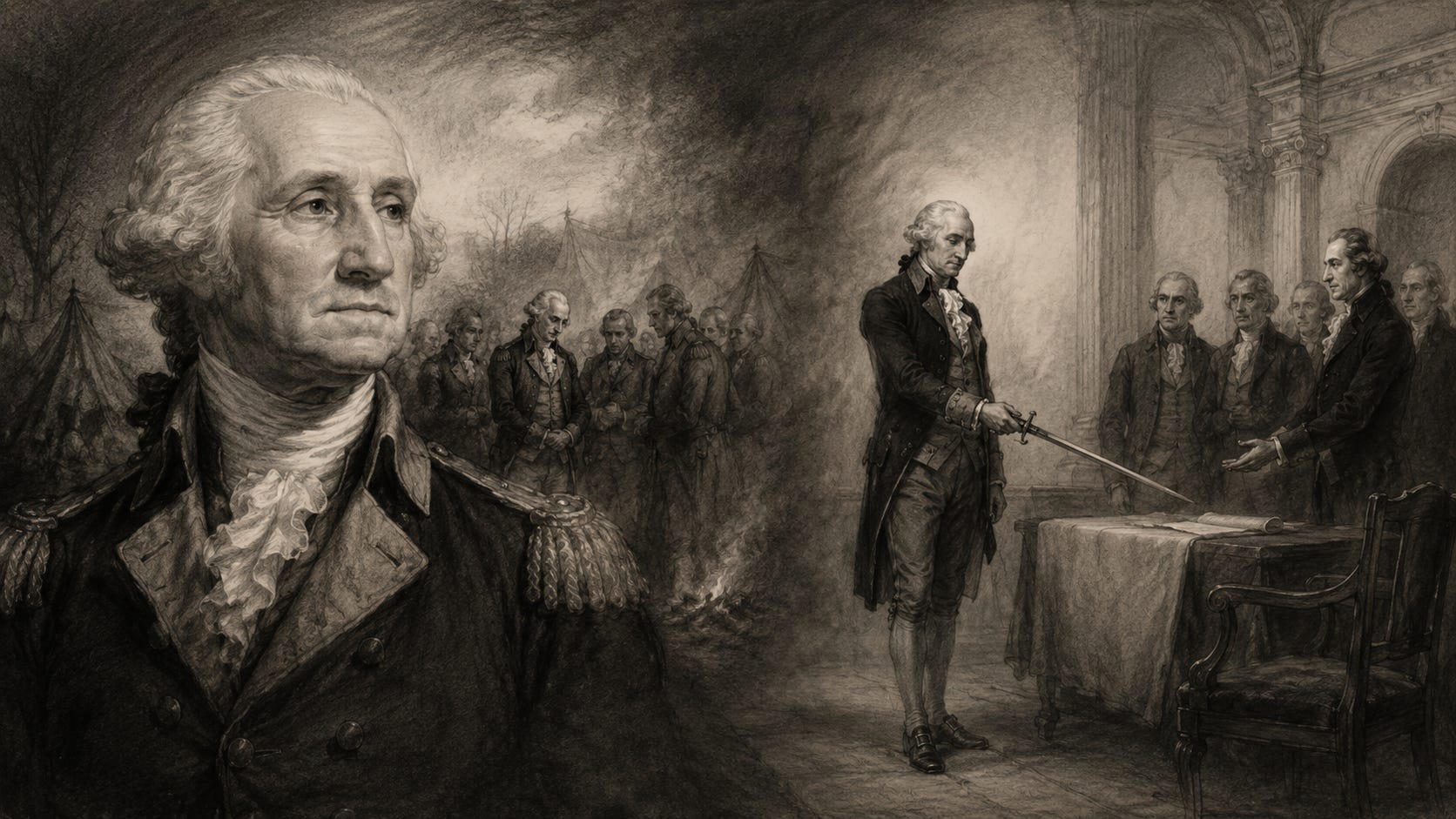
Our founding generation built a country around a different assumption: that the highest virtue available to a powerful person was the willingness to stop. To step back. To leave power on the table when stepping forward was still an option. To refuse the third term, the second escalation, the next deal, the additional acquisition, the further consolidation. To know when one had done enough.
That assumption was anchored by a single name. Washington. And the entire architecture of restraint that holds up American leadership at its best traces back to what he did with the position he had earned.
That assumption is now in trouble.
The Newburgh Moment
In March of 1783, the Continental Army was camped at Newburgh, New York. The war was effectively won, but Congress had not paid the officers. A faction was forming. They were ready to march on Philadelphia and force the issue. Some of them wanted to make Washington king. Most of them just wanted what they were owed, and they were prepared to use the force they commanded to get it.
Washington walked into the meeting where the conspiracy was about to take its final shape. He gave a speech that did not move the room. The officers were polite but unconvinced. Then he started to read a letter from a congressman, and he stopped. He took out a pair of reading glasses, which his men had not seen him wear, and he said something close to this: gentlemen, you must pardon me. I have grown gray in your service, and now I find myself growing blind.
The room broke. The officers wept. The coup attempt died on the spot.
The lesson is what Washington did with the loyalty he had just secured. He had the army. The army would have followed him into the Capitol. He could have used that force. He chose not to.
Eight months later, he rode to Annapolis and resigned his commission to Congress. He handed back the sword. George III, when he heard that Washington intended to give up power voluntarily, reportedly said that if he did that, he would be the greatest man in the world.
Washington did it. The American experiment depended on his doing it, and he understood that.
Then he did it again. Two terms as president, and he walked away. Could have run again. Would have won. Chose not to. The two-term precedent held until Franklin Roosevelt, and the country amended its Constitution to put the restraint back where Washington had set it.
The country we inherited was built on a structural assumption: that powerful people would voluntarily limit themselves. Almost every American institution depends on that assumption holding somewhere in the system. When the assumption stops holding, the institutions start failing in ways that no procedural fix can address.
What Has Replaced It
What has replaced the discipline of restraint is the cult of more. More growth. More reach. More tenure. More authority. More leverage. More platform. More acquisitions. More influence. The leadership culture of this moment treats voluntary limitation as a category error, a failure of nerve or ambition that has to be explained rather than admired.
This is the air every leader currently breathes. The CEO who steps down before the board pushes him is seen as having lost something. The senator who declines to run again is seen as having faded. The founder who hands over operational control is seen as having capitulated. The strategist who calls for de-escalation is seen as soft. The executive who passes on the acquisition is seen as having missed it.
In each case, restraint is being read as weakness. And the people doing the reading are responding to the actual incentives of the current moment. Attention markets reward escalation. Quarterly earnings reward expansion. Political donors reward maximalism. Cable news rewards anyone willing to keep talking. The structures around modern leadership pull every leader toward more, and the people who resist that pull pay an immediate visible cost while the benefits of their restraint compound invisibly over decades.
Washington understood this asymmetry. He understood that the things restraint produces, like institutional credibility and durable peace and earned succession, do not show up in any current measurement. They show up later. They show up in the country still functioning when he is gone. The reward for restraint is delayed and impersonal. The reward for grabbing more is immediate and felt directly. The leader who chooses the first over the second is choosing against everything the present rewards.
What Restraint Actually Looks Like
Restraint is operational discipline, often mistaken for spiritual posture. It is a set of specific moves that the strongest leaders practice with care, often without naming what they are doing.
Restraint is the deal you decline because the price you would pay in culture or focus is greater than the revenue is worth. Restraint is the meeting you do not call because the answer can be reached without you. Restraint is the decision you do not make because the person two levels down needs the experience of making it. Restraint is the public statement you do not issue because the situation is volatile and your weight on the scale will distort it. Restraint is the leverage you have over a counterparty that you choose not to exercise, because the relationship matters more than the moment. Restraint is the third term you do not seek, the additional acquisition you walk away from, the argument you do not finish, the post you do not publish, the response you do not send.
Each of these choices requires more effort, more discipline, and more clarity than the alternative would have required. Stopping short of what you could do is harder than doing it. That is why almost no one practices it.
The framework in Honor Under Pressure names this The Restraint and identifies it as one of the structural code elements that holds a working leadership identity together. The Restraint is voluntary limitation practiced as a regular operating discipline. It is what separates leaders who build institutions that survive them from leaders who consume the institutions around them in the course of trying to lead.
The Five-Part Practice
If you suspect that restraint has gone missing from your own working repertoire, the practical work breaks into five pieces.
First, write down three things you could legitimately do this quarter and have chosen not to. Be specific. The list should name the actual moves you are declining, the acquisitions you are passing on, the escalations you are not pursuing, the authority you are not asserting. If the list is empty, restraint is not currently part of your practice.
Second, set yourself a personal term limit for your current role. Private, written down, with a date, even if no one else has imposed one. The discipline of having an internal sunset on your own tenure changes how you make every decision before that sunset arrives. It forces you to build for succession from day one rather than from the day the board raises the question.
Third, practice strategic non-response on at least one channel where you currently respond reflexively. This might be social platforms, internal messaging, customer escalations, or public commentary. The exercise is to develop the muscle of not engaging when engagement is technically available and would feel productive in the moment.
Fourth, develop a successor before you need one. One specific person whose authority and visibility you are deliberately expanding, whose decisions you are deferring to where appropriate, and whose mistakes you are willing to absorb in the short term to build their capacity for the long term. If the role you currently hold could not be transferred within ninety days, you have not been practicing restraint.
Fifth, write your own Farewell Address. Two pages, drafted in quiet hours, that name what you believe the institution you serve will need most after you leave, what you would warn your successor against, and what voluntary limits you wish you had imposed on yourself earlier. Update it annually. The exercise will tell you, faster than any other diagnostic, how aligned your daily practice is with the legacy you intend to leave.
The Cost of Its Absence
The absence of restraint is the most expensive condition in current leadership, and the cost is showing up in every domain it has touched. It shows up in companies whose founders cannot let go and whose institutions hollow out behind them. It shows up in political careers that extend past every honest measure of usefulness. It shows up in escalation cycles that have no off-ramp because no one is willing to be the first to stop. It shows up in family businesses where the patriarch will not yield. It shows up in the slow erosion of every working relationship where one party will not let the other party finish a sentence.
The country was built by people who understood that the leadership virtue most worth practicing was the one that left power on the table. They built the architecture of American government around that assumption. They built their personal codes around it. They built their reputations on the moves they did not make.
We have inherited the architecture without the discipline. The architecture is now under more strain than it has been in living memory, and the strain is coming from the simple fact that almost no one is practicing the virtue that the architecture was designed to require.
The leaders who do practice restraint will be the ones still standing when the present cycle ends. The reward is delayed. The reward is impersonal. The reward is durable.
Washington understood the trade. He left power on the table because he knew the country needed the example more than he needed the office. The hardest move he made was the one he chose not to make. Everything he built rested on it.
Washington’s restraint is one of five leadership modes profiled in Honor Under Pressure, Book One of The Fourth Turning Leader series. Interactive tools for working through your own version of voluntary limitation, including the Bright Line Test, the Midnight Test, and the Compromise Calculus, are available at www.thefourthturningleader.com.
Very informative article. Your comment is so insightful: leadership holding on and on, and not letting go, has completely destroyed the political system in most parts of the world. I do not want to single out the politician who has just returned after 3 months of hibernation at the tax payer's expense. And the tragedy is that if he were to contest he would win hands down! Whatever happened to GEN Z and the millennials who need to hold leadership accountable and say enough is enough , "we thank you for your service to the nation, grandpa or grandma." Thanks for a great read.