


The talks in Islamabad lasted twenty-one hours. They ended with no deal, a brief press conference, and the specific kind of diplomatic language designed to obscure the obvious. Vice President Vance told the world that Iran had chosen not to accept American terms. Iranian state media told the world that Washington made excessive demands and was looking for an excuse to walk away. Both descriptions were probably accurate. That is the part worth taking seriously.
When the news broke last night, I was not in the least bit surprised. Neither would you be, if you had done the one exercise that almost no one does before sitting down at an important table: map the incentive structures first, honestly, before you have a preferred outcome to protect.
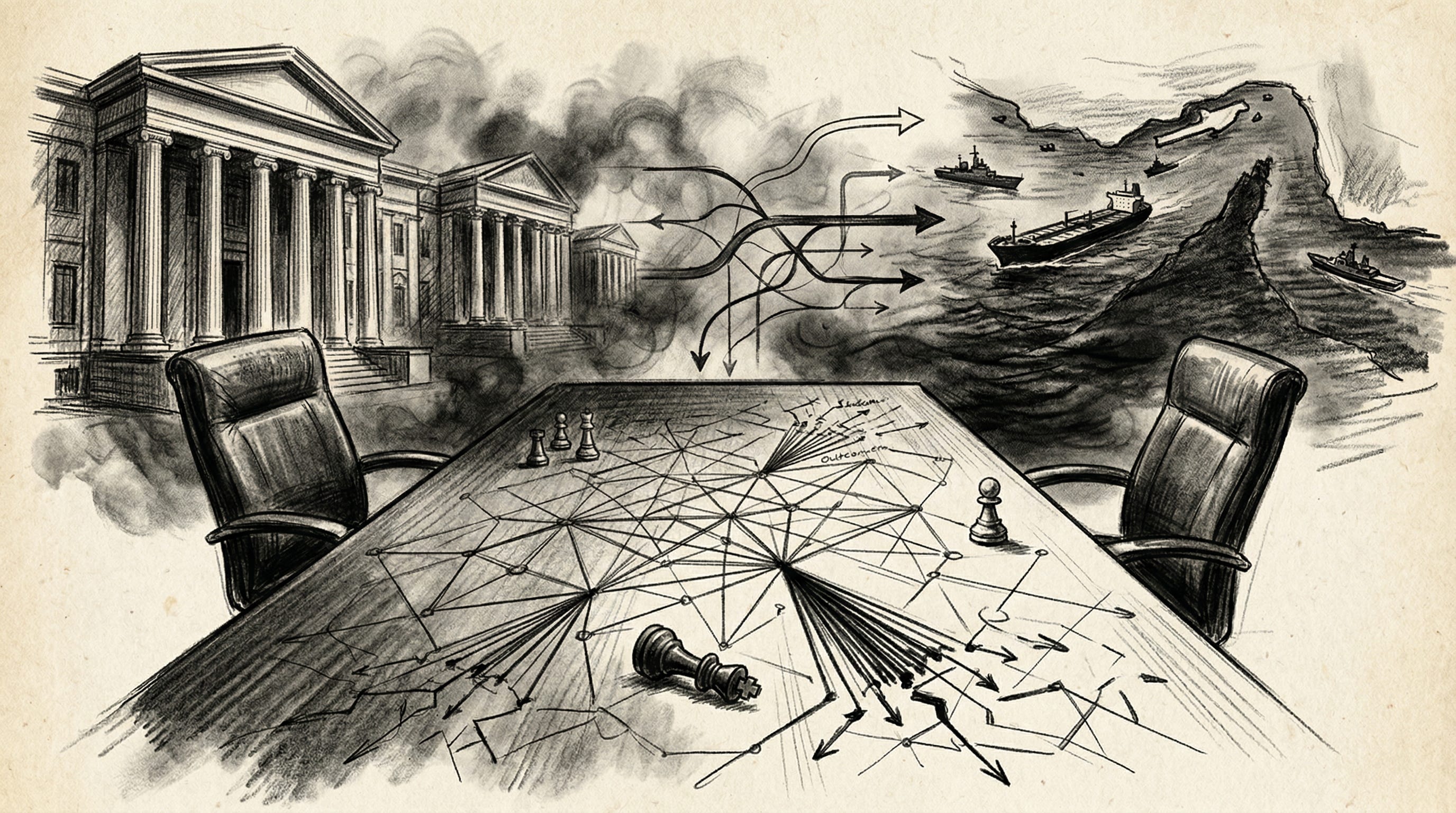
Charlie Munger spent six decades watching human beings make decisions, and he distilled it to a single line worth more than most graduate coursework in political science, organizational behavior, or negotiation theory combined.
“Show me the incentive and I’ll show you the outcome.”
The ancient Romans said it first, cui bono, who benefits, but Munger stripped away the Latin dignity. Incentives don’t care about your preferences. They don’t negotiate. They produce their results, and if you are surprised by what happens, it means you weren’t paying honest attention to the structure going in.
The Islamabad failure was not a diplomatic failure. It was a predictability failure. And before I explain what happened in that room, I want to explain why it matters far beyond geopolitics, because I see this exact failure mode play out constantly, in business negotiations, hiring decisions, lending relationships, partnerships, and organizational dynamics. The mistake is always the same. We look at what we want to happen, and we reverse-engineer a theory about the other party’s behavior to justify that preference. What we almost never do is start from the incentives and follow them honestly to wherever they lead.
What Each Side Was Actually Optimizing For
To understand why Islamabad collapsed, you have to understand what each party was actually optimizing for, not what they said they wanted, but what they were structurally rewarded for doing.
The United States, in its stated position, wanted a firm, long-term commitment from Iran to halt its nuclear weapons program. That sounds like a reasonable ask until you map it against Tehran’s actual incentive structure. Iran’s revolutionary government has watched, in real time, what happens to regimes that surrender strategic leverage in exchange for diplomatic goodwill. They watched Muammar Gaddafi negotiate away Libya’s nuclear program in 2003. They know how that story ended. They watched Saddam Hussein insist he had no weapons of mass destruction and get no credit for it. From Tehran’s vantage point, nuclear capability is the only insurance policy they have against regime change. Asking them to surrender it before the conflict resolves is not a difficult ask. It is an existential ask. No one, in the history of organized human behavior, has ever willingly surrendered their existential insurance policy at the negotiating table. Incentives don’t allow for it.
Meanwhile, the American side has its own incentive pressures, and they don’t point toward compromise either. Domestic politics in the United States reward confrontation on Iran. There are powerful constituencies, in Congress, in the defense establishment, in the media ecosystem, for whom a deal creates more problems than it solves. Vance’s framing after the talks, that this was “bad news for Iran much more than it’s bad news for the United States,” was not diplomatic analysis. It was audience management. That language only makes sense if the speaker is optimizing for a domestic reception, not an international outcome.
When both parties are structurally rewarded for not making a deal, the deal does not get made. This is not complicated. The incentive map predicted exactly this outcome before the first delegation boarded the plane. The twenty-one hours were theater. Necessary theater, perhaps, but theater.
Why We Keep Getting Surprised
Barbara Tuchman spent years studying one of the greatest predictability failures in human history: the summer of 1914, when every European leader sleepwalked into a war that none of them claimed to want. Her conclusion, documented with meticulous precision in The Guns of August, was not that these leaders were stupid. It was that they were committed to models of each other’s behavior that bore no relationship to the actual incentive structures in play. Every general assumed the war would be short, because their models demanded it. Every diplomat assumed the other side would blink, because their models demanded it. The actual incentives, nationalism, the interlocking logic of mobilization timetables, domestic political survival, pointed toward exactly what happened. Nobody was willing to read them honestly, because doing so would have forced uncomfortable conclusions.
We have not meaningfully improved on this since 1914. We still routinely enter high-stakes situations having studied what we want, rather than having mapped what the other party needs. We prepare our arguments without preparing our understanding of the audience. We optimize our pitch without asking what success looks like from the other side of the table, and whether that version of success is compatible with ours.
The cost is predictable. You lose deals you thought you had. You hire people who leave in eighteen months. You build partnerships that fracture over disagreements that were always there in the incentive structure, just never examined. You walk out of Islamabad having spent twenty-one hours learning what the incentive map would have told you in twenty-one minutes.
The Same Structure, Every Table
The Iran talks are a vivid case study because the scale is enormous and the failure is public. But the structure of the failure is not unique to geopolitics. It is the default failure mode of human beings operating in situations where they have something at stake.
An entrepreneur walks into a capital conversation assuming the investor wants what they want: a funded business with strong potential. But the investor is optimizing for something different, portfolio fit, risk-adjusted return, the optics of the bet within their own firm, the timeline pressure of their fund cycle. Those incentives may or may not align with what the entrepreneur is offering. Whether they align is not a matter of chemistry or how good the pitch deck is. It is a matter of structural compatibility. The entrepreneur who maps that structure before the meeting has a fundamentally different conversation than the one who walks in hoping goodwill carries the day.
A hiring decision operates the same way. A candidate is optimizing for advancement, compensation, the credential the new role adds to their trajectory. The organization is optimizing for execution, cultural fit, long-term commitment. These may point in the same direction, or they may not, but neither party is required to name the misalignment out loud. They just live with the consequences of it later. Most turnover is not a surprise if you mapped the incentives at the point of hire. Most of it was visible. It just wasn’t looked at honestly.
The same dynamic runs through client relationships, vendor negotiations, strategic partnerships, and organizational politics. In every case, the question is identical: what is each party actually rewarded for doing, and does that reward structure point toward the outcome we are both saying we want? When the answer is yes, relationships are durable. When the answer is no, no amount of effort, goodwill, or communication skill fixes the underlying misalignment. You are building on the wrong foundation, and at some point the structure tells you so.
The Discipline of Reading Incentives First
Munger’s axiom works in both directions. If incentives predict outcomes, then anyone willing to do the honest work of mapping incentives before a consequential decision can predict outcomes too. This is not a gift reserved for Munger or for people with decades of pattern recognition behind them. It is a discipline, available to anyone willing to ask the right questions before they need the answers.
The practice is straightforward, even if the execution takes courage. Before any significant decision involving another party, make the incentive map explicit. Write it down. Ask what the other party actually gets rewarded for in this context. Ask what failure looks like from their vantage point, because their definition of failure is almost never identical to yours. Ask what they would have to give up to give you what you want, and whether giving it up is something their incentive structure permits. These answers are almost always available. They require observation and intellectual honesty, not inside information.
Then do the harder version of the same exercise on yourself. Ask what you are actually optimizing for. Is it the stated goal, or is it something else? Are you pursuing this deal because it is the right deal, or because the process has gone on long enough and you need it to be over? Are you holding a position because it is the right position, or because reversing it feels like a loss? In Honor Under Pressure, I argue that the leaders who fail under sustained pressure almost never fail because they misread the external environment. They fail because they never built the discipline of reading themselves honestly, their own incentives, their own rationalizations, their own quiet compromises. The same failure shows up here. The external map is difficult enough. The internal map is where most people simply refuse to go.
Finally, look for the structural misalignment before you commit resources to bridging it. If what you need and what the other party needs point in genuinely incompatible directions, cleverness and persistence will not reconcile them. This is what twenty-one hours in Islamabad made undeniable. The United States required nuclear commitment. Iran’s government required nuclear capability for regime survival. Those are incentive structures pointing in opposite directions. No framing, no creative language, no late-night session closes that gap. The gap was there before anyone shook hands. It just took twenty-one hours to confirm what the map already showed.
Two Chairs, One Lesson
I see this from two vantage points, and they arrive at the same place by different roads.
From the CEO’s chair, incentive mapping is the most underused tool in business leadership. At B:Side, we make lending decisions that require us to understand not just what a borrower is telling us, but what they are structurally positioned to do. Those are not always the same thing. A business owner may genuinely believe their projections. But if their incentive structure rewards optimism and punishes the kind of hard internal accounting that produces accurate forecasts, the belief doesn’t change the outcome. We have learned, sometimes the hard way, that the most important question is never what someone intends. It is what they are rewarded for doing. The deals we have walked away from have almost always been deals where the incentive structures, mapped honestly, pointed somewhere we didn’t want to go.
From the professor’s chair, the gap is more personal and more urgent. I watch students prepare for job interviews by researching companies, rehearsing answers, and sharpening their stories. These are not wasted efforts. But I almost never see a student walk into a conversation having mapped the incentive structure of the person sitting across from them. What is that hiring manager actually rewarded for when a hire works out? What does their professional reputation require them to avoid? What does the organization’s incentive structure demand of new entrants, and is that compatible with what the student actually wants from the role? These questions are not hidden. They are available. They require only the willingness to ask them before the conversation starts rather than after it ends badly.
The lesson is the same from both chairs. Preparation that doesn’t include incentive mapping is incomplete. It is the equivalent of building a model without one of the key variables, and then wondering why the output doesn’t match the result.
The Question Worth Wrestling With
The Islamabad talks collapsed on April 12, 2026, and the world expressed surprise. The incentive structures were visible. They were on the record. They pointed to exactly this outcome, and anyone who mapped them honestly before the first delegation landed in Pakistan would have told you so.
The question that matters now is not what happens next in the Gulf, though that question carries real weight. The question that matters is what in your own world you are reading through the lens of your preferred outcome rather than the lens of the actual incentive structure. What negotiation are you walking into assuming the other party wants what you want? What decision are you about to make based on what someone said, rather than what they are rewarded for doing?
Show me the incentive and I’ll show you the outcome. This is the work. Do it before you sit down. Do it honestly, which means being willing to see things that complicate your preferred narrative. It will not always produce the result you want. But it will eliminate the worst outcome available to any leader: arriving at a result you should have seen coming, and finding you weren’t ready for it.
The signals are almost always there. The discipline is in choosing to read them.
Honor Under Pressure is available now. The full series, along with ongoing resources and community for leaders navigating the Fourth Turning, lives at www.thefourthturningleader.com.