


Last Friday afternoon (7.10.26), the S&P 500 closed at 7,575, up again, a few percentage points from its all-time high. The Nasdaq finished at 26,281. The financial press summarized the session with a phrase that should be etched somewhere prominent for future historians: traders “looked past tensions in the Middle East.”
On Saturday evening (7.11.26, just a little while ago as of this writing), Iran’s Revolutionary Guard navy fired on a commercial container ship transiting the Strait of Hormuz, struck it, and declared the strait closed indefinitely. Within hours, the United States began conducting strikes against Iranian targets in and around the waterway. Crude prices jumped roughly three percent in early weekend trading, before most of the world had even seen the headlines. The fragile ceasefire that has held, barely, since June is now functionally dead.
Think about that for a moment. On Friday, the most expensive stock market in modern American history closed near record highs while the ceasefire it was pricing as permanent was already visibly failing. By Saturday night, warships were exchanging fire in the channel that carries a fifth of the world’s oil.
That gap, between what the market believes and what the world is doing, is the subject of this piece.
A Crisis That Never Actually Ended
Regular readers know I wrote about the Strait of Hormuz back in March, when the first closure stranded roughly twenty thousand mariners and two thousand ships in the Persian Gulf and I called it the forty-mile hostage crisis. It is worth recapping how we got here, because the market’s amnesia on this subject is part of the problem.
In late February, coordinated American and Israeli strikes on Iran killed the Supreme Leader and triggered a spiral of retaliation. Within weeks the IRGC had mined the strait, attacked merchant shipping, and choked traffic to a near standstill. Brent crude went from double digits to a peak of $126. Dubai crude hit a record $166. Gulf producers cut output by ten million barrels a day. Fertilizer prices rose fifty percent. Then came a partial reopening, tolls of more than a million dollars per vessel, a collapsed reopening, another reopening, and finally the June memorandum that everyone agreed to call a ceasefire.
Here’s the truth: the strait never really reopened, and the war never really ended. It merely went quiet enough for markets to stop looking at it. Tankers were attacked again on July 7. By July 9, traffic through the strait had ground to a near halt. On Friday, Washington issued an ultimatum demanding Iran publicly declare every channel open and toll-free by Saturday. Iran’s answer came in the form of gunfire aimed at a container ship.
Not slowly, not quietly, not at some hypothetical future date: the confrontation is re-escalating now, with American munitions striking Iranian targets and the IRGC promising “severe” retaliation.
And through all of it, from the February strikes to this weekend’s exchange of fire, the Nasdaq rallied to new all-time highs.
The Most Expensive Market in a Century
Let me be clear about what this piece is and what it isn’t. I am not predicting a crash on a schedule. Nobody can do that, and you should be deeply skeptical of anyone who claims otherwise. What I can do is describe the conditions, because the conditions are extraordinary.
The Shiller CAPE ratio, which measures the S&P 500 against ten years of inflation-adjusted earnings, sits at roughly 41.8. In the entire recorded history of that metric, spanning more than 150 years, it has been higher only once: the final months of the dot-com bubble. The long-term average is about 17.
The Buffett Indicator, total US market capitalization measured against GDP, recently crossed 230 percent, an all-time record. For perspective, it peaked near 140 percent in March 2000, just before the Nasdaq lost more than three quarters of its value. Warren Buffett himself wrote in 2001 that when this ratio approaches 200 percent, “you are playing with fire.” We are not approaching 200 percent. We are a full thirty points beyond it.
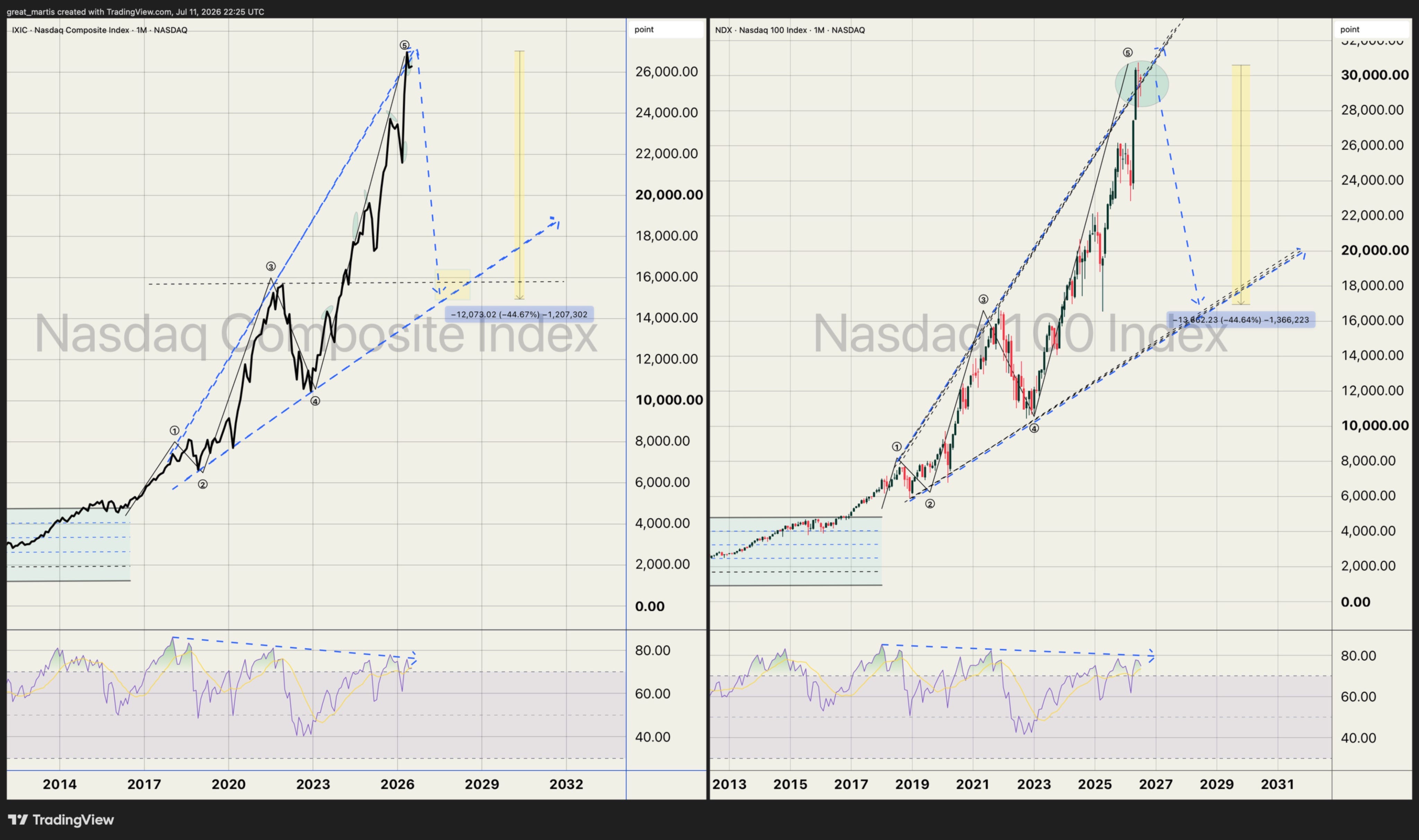
This is the context in which a widely followed technician published a chart this week arguing that the major indices face a decline of forty percent or more from current levels, with the only open question being, in his words, the “angle of descent.” His wave counts and trendlines are interpretive, as all technical analysis is, and I hold them loosely. But I could not shake that phrase, because it reframes the debate in exactly the right way. At these valuations, the question is not really whether the market reverts. Markets always revert from extremes; that is what makes them extremes. The question is whether the descent is a slow glide over a decade of disappointing returns or a sudden drop compressed into quarters. History suggests the difference between those two paths usually comes down to a single variable.
A catalyst.
1973 and the Anatomy of a Catalyst
Students of market history will recognize this setup, because we have run this experiment before.
In the early 1970s, American investors fell in love with the Nifty Fifty: a small group of dominant growth companies, Polaroid, Xerox, Coca-Cola, IBM, that were considered “one-decision stocks.” You bought them and never sold, because their growth was inevitable and their franchises were unassailable. Valuations stretched to levels that made no arithmetic sense, and sophisticated people constructed elaborate justifications for why the old math no longer applied. The market grew narrow, expensive, and serenely confident, all at once.
Then, in October 1973, war broke out in the Middle East, and Arab oil producers embargoed the West. Oil quadrupled. Inflation, already smoldering, caught fire. The Federal Reserve was forced to tighten into a slowing economy, and by the bottom in late 1974 the S&P 500 had been cut nearly in half from its peak. The Nifty Fifty, those unassailable one-decision stocks, fell further still, and some took a decade to recover.
Here is what matters about that episode: the embargo did not cause the bear market. The valuations caused the bear market. The embargo merely selected the date. Overvaluation is the dry forest; the catalyst is only the match. And the cruelest feature of oil shocks in particular is that they attack an expensive market at its most vulnerable point, because they push inflation up while pushing growth down, which strips central banks of their ability to ride to the rescue. The Fed put, the assumption that rescue is always coming, works in a deflationary crash. It does not work at $150 oil.
Now look at the present arrangement. A market more concentrated in a handful of AI champions than at any time since, well, ever. Valuations exceeded only by 1999. A collective belief that these companies’ growth is inevitable and their franchises unassailable. And this weekend, a shooting war in the body of water that carries twenty percent of the world’s oil, with the world’s largest military now striking targets along its shores.
I don’t know if this is the catalyst. Nobody does; the strait has closed and reopened before, and markets shrugged each time. But notice that the shrugging is itself part of the pattern. Hyman Minsky taught that stability breeds instability, that every uneventful day strengthens the conviction that days will remain uneventful. Each time the market looks past a Hormuz closure and gets rewarded for it, the reflex deepens, positioning grows more aggressive, and the eventual repricing gets larger. The market has cried wolf about the wolf, if you will. The fable does not end with the wolf never showing up.
The Economy That Never Got Invited to the Party
The loan files that cross my desk at B:Side tell a different story than the indices do. Small business owners are still digesting the spring’s fuel costs, freight surcharges, and fertilizer prices. Their margins have no cushion left for a second oil shock. The regional banks that serve them are still nursing balance sheets marked for a rate environment that may be about to lurch again, in the wrong direction, if energy inflation forces the Fed’s hand. Wall Street’s euphoria and Main Street’s exhaustion have been diverging for two years. Events in the strait threaten to resolve that divergence the hard way.
And there is a generational dimension to this that worries me just as much. Most of the young professionals entering the workforce today, including the students in my classroom at ASU, have never experienced a real bear market. They have learned from every dip since 2020 that drawdowns are buying opportunities that resolve in weeks. An entire cohort has been trained by the most forgiving decade in market history. The dissonance between what the data shows and what their experience has taught them is one of the things that keeps me up at night, and it is why I refuse to stay quiet just because the timing is unknowable.
The Playbook
So what do you actually do? Not as a trader, but as a leader, an owner, a steward of a household or a team. A few disciplines matter more than any forecast.
Stress test now, while it’s cheap. Run your business and your personal finances against $150 oil and a 30 to 40 percent equity drawdown. Not because either is certain, but because the exercise costs nothing today and everything later. If the numbers break, you want to know on a quiet Sunday, not in the middle of the storm.
Prize liquidity over cleverness. In every crisis I have lived through, from the BodeTree days to the regional bank strains we watch at B:Side, the winners were rarely the smartest people in the room. They were the ones with cash and committed credit when others had neither. Boring balance sheets are what buy the bargains.
Ignore the sirens on both sides. The permabears will tell you to sell everything; they have been wrong for fifteen years. The permabulls will tell you valuation never matters; they were saying that in March 2000 too. Position so that you are never forced to be a seller, and a forty percent decline becomes an event you endure and exploit rather than one that ends you.
Lead visibly. If you run a team, your people will read this weekend’s headlines and look at you. Calm is contagious, and so is panic. Marcus Aurelius reminded himself that the mind adapts and converts every obstacle into fuel. Say plainly what you know, what you don’t, and what the plan is. That conversation, held early, is worth more than any hedge.
The Descent Is the Terrain
Here is where I land. The market is priced for a world without accidents, and we live in a world that is currently producing accidents on a weekly basis. Whether this weekend’s fire in the strait proves to be the catalyst or merely another rehearsal, the underlying arithmetic does not change: from a CAPE of 42, the next decade’s returns will be earned the hard way, and some portion of the descent, gentle or violent, is coming regardless.
The worst thing you can do is pretend the risk isn’t real. The second worst thing is to liquidate everything and hide, surrendering to a forecast that no one, bull or bear, can actually make. The people who come through periods like this intact are the ones who prepare while others party, who hold enough liquidity to act when others can’t, and who understand that surviving the angle of descent matters more than predicting it.
The forest is dry. The matches are lit and falling. You cannot control the weather in the Strait of Hormuz, but you can control whether your house is made of tinder.
That has always been enough. It still is.
P.S. If this piece resonated, it’s because moments like this one are not really about markets. They are about leading through a period of historic upheaval, what Neil Howe calls a Fourth Turning, when institutions buckle and the old rules stop working. I’ve been building a dedicated home for that conversation at thefourthturningleader.com, focused on the leadership disciplines this era demands. If you lead anything, a company, a team, a family, I’d encourage you to join me there.