


We’ve all heard it, in the hallways, in the group chats, in the slight pause before someone answers the question “how are things going?” There is a word we keep reaching for and then putting back down because it doesn’t quite fit, and that word is unprecedented. It gets applied so often now that it has lost its function. But the past two weeks gave the word some of its weight back.
On the geopolitical front, the United States and Iran moved through the first direct military conflict of that magnitude in modern history to a moment Tuesday evening when the President issued a public ultimatum: a “whole civilization will die tonight, never to be brought back again” if the Strait of Hormuz was not reopened by 8 p.m. Eastern. A ceasefire was announced with less than two hours to spare. By Wednesday morning, Israel had launched large-scale strikes on Lebanon, Iran’s Revolutionary Guard had declared the strait closed again, and both sides were accusing the other of bad faith before the terms had even been distributed. The ceasefire that was supposed to open two weeks of formal negotiations was fracturing in real time, with markets watching and oil prices swinging on every dispatch.
The economic picture had already absorbed the blow. Roughly twenty percent of global oil trade moves through that forty-mile chokepoint, and the disruption had been running long enough to reach supply chains, energy costs, and the balance sheets of small businesses that carry no geopolitical exposure in any direct sense but cannot escape the downstream pressure. Tariff uncertainty was compounding the picture. The fiscal architecture of the country was producing interest payment obligations that, for the first time in peacetime, exceeded defense spending. The margin for error was narrowing on multiple axes simultaneously.
And then, in an entirely separate domain, one of the leading artificial intelligence laboratories in the world announced that it had built a model so capable of autonomous offensive action in the digital realm that it would not be releasing it to the public. Anthropic’s Claude Mythos, as it became known after an accidental document leak, could autonomously discover and chain cybersecurity exploits across major operating systems and software at a scale its own creators described as potentially catastrophic if broadly available. The company launched a restricted program, Project Glasswing, limiting access to approximately fifty vetted organizations focused on defensive security. The most sophisticated AI laboratory in the world built something and then told the rest of us: this one is too dangerous to share.
Three domains. Three different kinds of disruption. All of them arriving in the same week, in the same news cycle, competing for the same anxious attention.
Call it what it is: a perfect storm. Difficult does not come close.
What It Feels Like From the Ground
The conversations happening across my network right now keep arriving at the same place, and it is something quieter than anger. Closer to exhaustion than outrage. More resigned, with a heaviness that does not have a clean name. Panic implies a single acute event with a visible endpoint. What I keep hearing is something more corrosive: a sustained state of not knowing which variable to plan around, because the variables that used to be stable are now moving in combination. Interest rates, supply chain reliability, labor market norms, the prospect of AI reshaping cost structures and competitive landscapes all at once. These are resilient people. They have navigated hard things before. But they built their businesses and their careers inside a framework of assumptions that is no longer holding, and the conversations keep arriving at the same wall: no one has a replacement framework, because the replacement does not yet exist.
The leaders I speak with are reaching for their tools and finding that the outputs no longer match what they observe around them. The strategic plan was built on projections that were reasonable six months ago. The consensus process is moving at a pace the situation has already lapped. The metrics they were trained to track are telling one story; the market is telling another. This is not a failure of competence. It is a failure of fit. Process-dependent leadership in a situation that has rendered the process a lag indicator.
And then there are my students. They are carrying something harder to name than frustration, and I sit with it every time I walk into a classroom. Something quieter and more resigned than anger. They did everything they were told to do. They built the credentials, showed up with the work ethic, prepared for the interviews. The ladder they were promised has been quietly moved, and no one had the honesty to warn them before they had spent years and significant money climbing toward something that was already ending.
The Pattern Behind the Storm
Regular readers of these pages know the Fourth Turning framework well. The historians William Strauss and Neil Howe identified a recurring eighty-year cycle in American history: a period of deep institutional crisis that restructures the entire order, clears what is no longer serving the republic, and defines the generation that lives through it by the quality of the choices made under maximum pressure. The Revolution. The Civil War. The Depression and World War II. And now this. We have covered this ground before, and at length, because naming the pattern accurately is not a small thing.
What a Fourth Turning does to leaders is specific and predictable. It collapses the middle ground, eliminating the moderate positions that calmer periods kept available. It strips process of its load-bearing function, because consensus mechanisms were designed to optimize within a stable system, not to function when the system itself is what is failing. And it runs long, far longer than the tools most of us carry were designed for: fifteen to twenty years of sustained pressure that outlasts intensity, exhausts cleverness, and eventually asks a question that strategy cannot answer.
The perfect storm described at the top of this piece is not a collection of simultaneous bad luck. It is the pattern announcing itself, in the same way it announced itself to every generation that has lived through a turning before this one. The leaders who feel like the ground has shifted beneath them are correct. It has.
The Problem With Diagnosis
But naming the pattern is not the same as answering it. Diagnosis without prescription is insufficient. Explaining the storm while people are standing in it, describing the failure of frameworks while leaders are reaching for those frameworks and coming up empty, eventually produces its own kind of paralysis. The writers and thinkers worth paying attention to do not stop at the observation. They push through to the question that follows: given that this is true, what do we actually do?
Leaders who misread the cycle, who apply Third Turning management to Fourth Turning conditions, produce outcomes far worse than the crisis itself. James Buchanan governing as though the institutions he inherited were still load-bearing, when they were not, is the clearest American example of what misdiagnosis costs. But Buchanan’s deeper failure was not that he misread the moment. It was that he had no answer for it even when the moment became undeniable. The diagnosis eventually reached him. The prescription never did.
That gap is what drove me back into the historical record, looking for an answer. Specifically: what did the leaders who actually navigated America’s prior Fourth Turnings have that the ones who collapsed did not?
What the Historical Record Actually Shows
The answer was not what I expected to find, and it was not comfortable. The leaders who held, held because they had built something inside themselves before the pressure arrived that functioned when everything external had failed.
Five figures anchored the research. Cato the Younger refused Caesar’s pardon because accepting it would have required becoming someone he could not be. Washington returned power to the republic before anyone asked him to, having built the restraint into himself long before the Newburgh conspiracy gave him the opportunity to violate it. Seneca is the warning portrait: his code was real, but insufficiently fortified against the specific mechanism by which sophisticated minds rationalize their own erosion, one defensible permission at a time. Lincoln’s moral architecture was still being rebuilt at the Second Inaugural, and his willingness to be remade by suffering is the most honest portrait of what character development under sustained weight actually looks like. Marshall spent a career making himself unnecessary by making everyone around him exceptional, and was at his desk in Washington on the night of June 5, 1944, while Eisenhower gave the order for D-Day, because he had built the situation that kept him from the room.
They were not the same kind of leader. They did not use the same mode. What they shared was something beneath mode: a moral architecture built through deliberate practice, internalized deeply enough to function automatically when the conscious mind was overwhelmed, tested against actual cost before the apex arrived. A practiced capacity. Behavior under genuine cost. The kind of code that holds because it has been tested, repeatedly, against conditions that made the comfortable choice genuinely available.
The conclusion that kept arriving, across two thousand years of history, is this: in a Fourth Turning, complexity fails and only character scales.
Character. A code. Something built before the pressure arrives, in the part of a person that holds when everything else has failed.
The Book
That conclusion is what made the book inevitable. Written as a response to the moment, for leaders who need something that functions when commentary runs out.
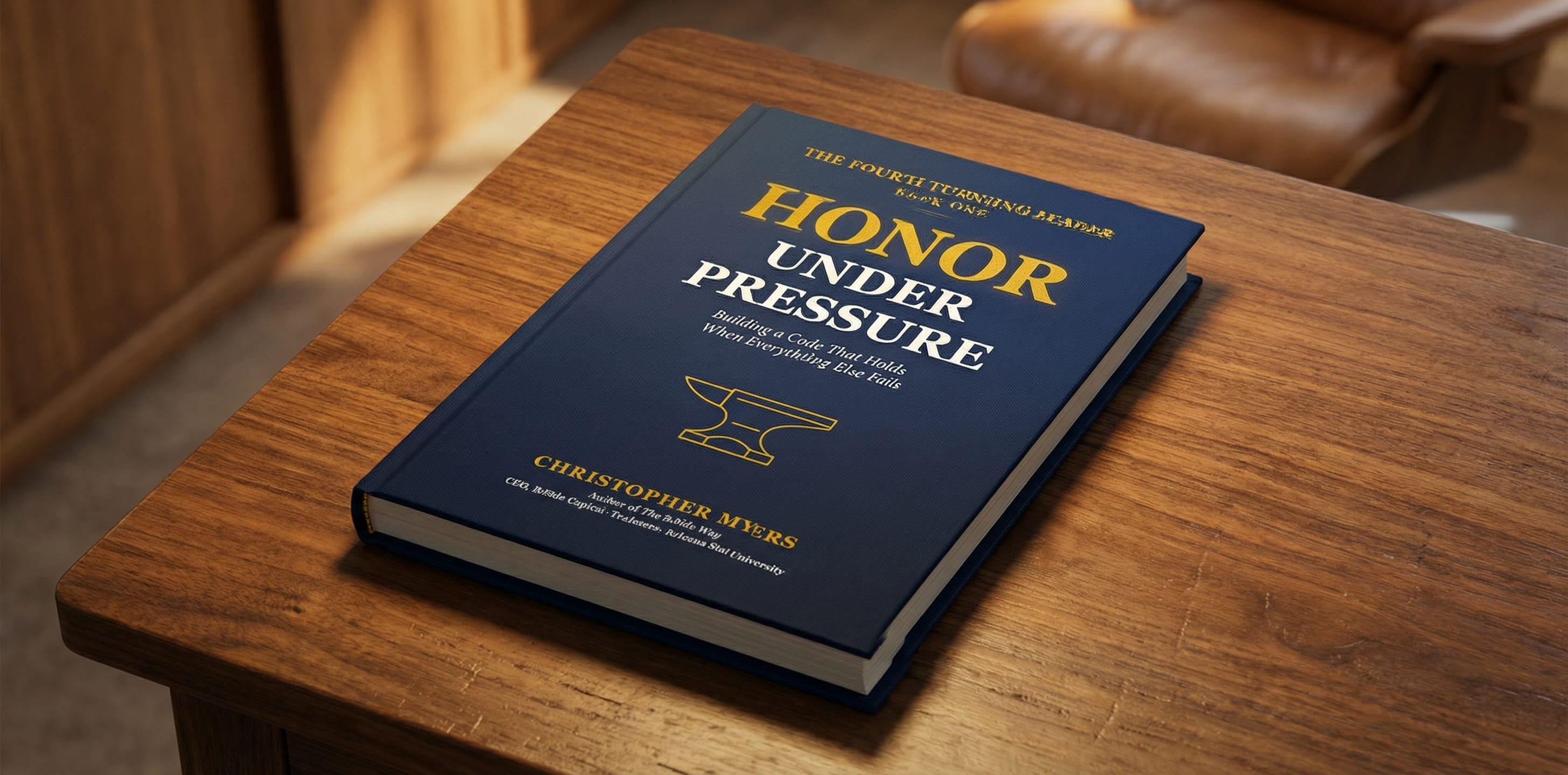
Honor Under Pressure: Building a Code That Holds When Everything Else Fails is Book One of The Fourth Turning Leader, a three-part series. This first volume addresses the individual level, which is where everything else has to start: what an honor code is, how it is built, what the five modes look like in historical practice, what the internal mechanisms are that cause codes to erode from within, and how to construct your own architecture before the apex demands it.
The book aims at something with more durability than inspiration. Inspiration has a short half-life, and the Fourth Turning runs longer than any inspirational feeling lasts. A working architecture is the goal: something specific enough to be broken, honest enough to survive scrutiny from the people who know you best, and personal enough that no one else could have written it.
These leaders were not exceptional people who arrived with exceptional character fully formed. The gap between the moral architecture they eventually carried and the one they started with was, in most cases, considerable. What separated them was the deliberate, sustained, sometimes costly work of building and maintaining a code in conditions that made the comfortable choice genuinely available, every day, for as long as the turning lasted.
That work is available to any leader willing to do it.
The series has a home at www.thefourthturningleader.com, where the ongoing work will live alongside resources from the second and third volumes as they develop.
What the Storm Is Actually Asking
The student sitting in my classroom who did everything right and is now watching the math not work out. The entrepreneur planning around variables that will not hold still. The executive whose consensus process has been lapped by a situation that did not wait for consensus. The military commander negotiating a ceasefire in the same hour that a separate conflict is fracturing its terms. The laboratory that built something and then announced to the world that it was too dangerous to share.
These people are failing, where they are failing, because the tools they were given were built for different conditions. The map is wrong. The territory has changed. Intelligence, work ethic, and good intentions are present and accounted for. The fit between those qualities and the demands of this moment is what has broken down.
A Fourth Turning does not fix that problem by handing out new maps. It fixes it by producing, from the pressure of the crisis itself, the leaders whose character became the new map. Washington did not wait for the republic to stabilize before building his code. Lincoln did not wait for the war’s moral clarity before carrying the weight. Marshall did not wait for the army to be ready before identifying the officers who would make it so.
The storm is here. It is producing the exact conditions that every prior Fourth Turning has produced at its apex: the collapse of middle ground, the failure of process, the compounding pressure across multiple domains simultaneously.
The question it is asking is whether we have built something to hold.
Honor Under Pressure is available now. The full series, along with ongoing resources and community for leaders navigating the Fourth Turning, lives at www.thefourthturningleader.com.