


Fifty years after the Arab embargo, we are still one contested strait away from civilizational fragility. The bill is coming due. Not slowly, not theoretically, not in some distant future that gives us time to adjust.
Brent crude touched $119 last week and the financial press treated it like weather — a passing front, soon to clear. Somewhere in a lower-third chyron, an analyst assured viewers that “markets are pricing in resolution.” Traders adjusted their models. Pundits moved on to the next segment.
They’re wrong. What we’re watching isn’t a price fluctuation. It’s a stress test of a civilization that spent fifty years choosing convenience over resilience, and the results are coming in faster than anyone in a television studio wants to admit.
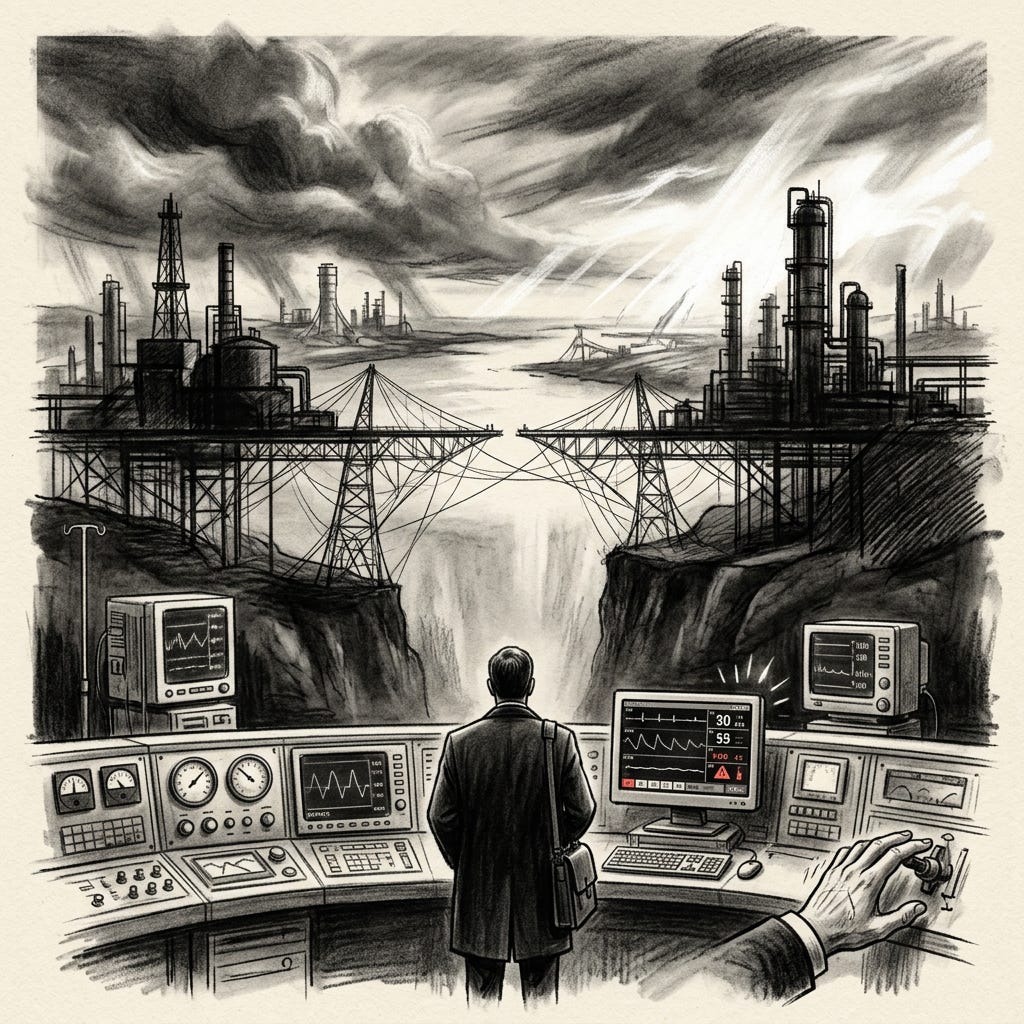
Four Times ‘73
The 1973 Arab oil embargo is the reference point everyone reaches for, so let’s start there — and then retire it, because the comparison actually understates our exposure.
That embargo removed roughly five million barrels per day from global supply. It quadrupled prices. It produced gas lines, stagflation, a geopolitical reordering of the Middle East, and a decade of economic malaise that ended a presidency and rewired American domestic politics. Five million barrels did all of that.
The current disruption to the Strait of Hormuz threatens twenty million barrels per day. Four times the magnitude. When the IEA’s Fatih Birol calls this “the largest oil supply disruption in history,” he is not being dramatic. He is doing arithmetic — the kind of arithmetic that should be front-page news in every financial publication on Earth but is instead buried beneath reassuring language about “eventual normalization.”
Every major oil shock in modern history has been underestimated in its early stages because analysts model economics while history delivers politics. The 1979 Iranian Revolution removed only four million barrels per day and it gave us a decade of stagflation and a president asking Americans to turn down their thermostats. Markets priced in resolution then, too. Resolution took ten years.
The persistent faith that wars in the Persian Gulf resolve cleanly is not an analytical position. It is a psychological defense mechanism dressed in a Bloomberg terminal.
Kharg Island Is Still Standing — For Now
Most people reading the headlines don’t understand the escalation ladder, so let me walk it rung by rung, because understanding the structure of what could happen next is the difference between preparation and paralysis.
Kharg Island processes ninety percent of Iranian oil exports. It remains standing today for one reason: American military planners chose restraint. That restraint is a policy decision, not a physical law. It can change with a phone call. Strike Kharg, and conservative estimates put Brent at $150 within seventy-two hours — removing eight million barrels from the market and exceeding the combined impact of the 1973 embargo, the Iranian Revolution, and Saddam Hussein’s invasion of Kuwait. Combined.
But Kharg isn’t even the ceiling. Iran’s joint military command has explicitly identified its retaliation targets, and the name at the top of that list should keep every energy analyst on the planet awake at night: Saudi Aramco’s Abqaiq processing facility. Seven percent of global oil supply flows through that single chokepoint. In 2019, a drone strike — a pinprick, an appetizer — hit Abqaiq and took weeks to partially restore. What Iran can deliver now would be categorically different in scale, precision, and intent.
And then there is the variable that no pricing model I’ve seen accounts for, the one that transforms a severe economic shock into something civilizationally different: desalination.
Saudi Arabia, the UAE, Kuwait, and Qatar produce the vast majority of their drinking water by desalinating seawater. Strike those plants and you have not created an energy crisis. You have created a humanitarian emergency without modern precedent — populations of millions facing evacuation, institutional capacity collapsing, the very workforce needed to restore oil production scattered across the region or worse. You are no longer removing barrels from the market temporarily. You are removing the human and institutional capacity to bring them back at all. The timeline shifts from weeks to years.
Michael Oren’s account of the Six-Day War remains essential reading precisely because it documents how Middle Eastern conflicts consistently exceed every participant’s “reasonable scenario” planning. Conflicts in this region do not respect the neat escalation frameworks built in Washington think tanks. They have a persistent, documented habit of going further and faster than anyone imagined, and then further still.
The Math Stops Working
Let me bring this down from geopolitics to your kitchen table, because that is where this crisis will actually be felt.
At $200 a barrel, gasoline hits roughly eight dollars a gallon in the United States. That is not an inconvenience for most American households. It is a restructuring of daily life. The two-income family commuting sixty miles round-trip doesn’t adjust their budget. They fundamentally cannot afford to get to work.
Every calorie in America travels by diesel. Grocery inflation at twenty-five percent or higher isn’t a forecast — it’s the mechanical result of fuel costs propagating through a logistics network that was designed for efficiency, not resilience. Airlines ground routes. Amazon’s delivery economics invert. The owner-operator — the backbone of American freight — parks his truck in the driveway because the math no longer works, because every mile driven costs more than the load pays.
David Hackett Fischer documented in The Great Wave that energy and food price shocks have preceded every major social upheaval of the past eight hundred years. This is not a modern phenomenon with modern solutions. It is a pattern so old and so consistent that ignoring it requires active effort.
Here is the class dimension that polite economic commentary refuses to name directly: the professional class will experience $200 oil as portfolio damage — a bad quarter, an uncomfortable conversation with a financial advisor, a deferred renovation. The working class will experience it as survival arithmetic. Heat or eat. Medicine or gas. These are not hypothetical dilemmas. They arrived in softer forms during 2022’s diesel spike. At $200 Brent, they arrive harder, faster, and for a much larger share of the population.
The 1970s gave us malaise over the course of years — a slow grinding down that became the background hum of an era. This would be different. The speed of modern supply chains, which is their great advantage in normal times, becomes their great vulnerability in disruption. The pain doesn’t build gradually. It cascades.
Fifty Years of Pretending
What makes this moment truly dangerous isn’t the price of oil. It’s the accumulated negligence that made us this vulnerable in the first place.
Run the timeline. 1973: the Arab embargo. Brief national alarm, talk of energy independence, some investment in alternatives. Then the price stabilized and we went back to sleep. 1979: the Iranian Revolution. Same cycle — crisis, rhetoric, reversion. 1990: Iraq invades Kuwait. Strategic Petroleum Reserve gets tapped, crisis passes, dependency deepens. 2008: oil hits $147 and the economy buckles. And each time, the same pattern: a season of concern followed by a longer season of comfortable amnesia.
“Energy independence” in American political discourse became a slogan untethered from strategy — something candidates said during debates and then filed away once the inauguration confetti was swept up. We substituted financial engineering for structural resilience. Futures markets, hedging instruments, strategic reserves — these are sophisticated tools for managing volatility within a system. They are not the system itself. You cannot hedge your way out of twenty million barrels disappearing from the physical market.
Nassim Taleb built an entire intellectual framework around this exact failure mode. In Antifragile, he identifies what he calls the “fragilista” — the person who builds systems optimized for efficiency in calm conditions and is then stunned when those systems shatter under stress. We have built a fragilista civilization with respect to energy. Every barrel of efficiency we squeezed out of our supply chains, every redundancy we eliminated in the name of cost optimization, every buffer stock we drew down because carrying inventory hurt quarterly returns — all of it was a bet that the calm would continue. The Strait of Hormuz is forty miles wide. We bet the entire architecture of modern life on forty miles of open water.
Marcus Aurelius governed the Roman Empire during the Antonine Plague, which killed between five and ten million people across two decades. He did not pretend the plague away. He did not convene a panel to assure Roman citizens that conditions would normalize. He adapted — raising new legions, restructuring tax policy, personally financing the war effort from the imperial treasury. He met the real conditions with real adjustments because Stoic philosophy demanded exactly that: see clearly, accept what is, act on what you control. We have done the opposite for half a century. We have practiced sophisticated denial and called it risk management.
The Fourth Turning framework helps explain why this negligence persists across generations. Strauss and Howe observed that crisis eras punish the accumulated complacency of the preceding cycle. The bill comes due not to the generation that incurred the debt but to the one that inherited it. The leaders who deferred structural investment in energy resilience during the 1980s, 1990s, and 2000s will not be the ones standing in line for gasoline or explaining to their employees why the business can’t absorb another month of input cost increases. Their children will. Your employees will. The communities downstream of every deferred decision will.
This is what makes the current moment a moral question, not merely an economic one.
What You Control, What You Build
So what do you do? Not abstractly. Not as a policy recommendation that requires congressional action or a UN resolution. What do you do in the sphere you actually command?
Lincoln’s most important leadership quality wasn’t optimism. It was the capacity to act decisively while holding profound uncertainty — to make choices with incomplete information and live with consequences he could not control. He learned, through genuine adversity, to stop waiting for the picture to be complete before moving. Because by the time the picture is complete, the window for action has usually closed. That quality is what this moment demands from every leader reading this.
Here is what acting now actually looks like:
1. Stress-test your operation for a sixty-day fuel shock. Not a one-week spike that the strategic reserve can blunt. Sixty days. Two full months of input costs jumping eighty percent. Map every expense line that is directly or indirectly exposed to transportation and logistics — and then ask honestly whether your margins survive it, or whether you need to restructure something before the shock arrives rather than during it. Most organizations have never done this exercise. Do it this week.
2. Audit your household and organizational supply chain dependencies. How many days of essential inputs — food, fuel, medical supplies, key materials — do you have on hand? Not in a prepper sense. In the basic prudential sense that every generation before the last two took for granted. Your grandparents kept a pantry stocked. They weren’t paranoid. They had living memory of what happens when systems fail. A thirty-day buffer in the things that matter most is not excessive caution. It is the minimum that a competent leader maintains.
3. Map your community’s critical vulnerabilities and put your name on one. If you lead within a community — as an employer, a board member, a local official — identify which local systems are most exposed to logistics breakdown: food distribution, fuel supply, medical logistics. These are knowable vulnerabilities, and most communities have done zero work to chart them, much less build contingencies. Pick one. Convene the people who need to be in the room. Start the conversation before the crisis makes it urgent, because urgent is too late.
The leaders who matter in the next eighteen months will not be the ones who called the price correctly. They will be the ones who stopped asking “when will things return to normal” and started building as if normal has already left the building.
Because it has.
The Forty-Mile Question
The Strait of Hormuz is forty miles wide. Through it passes twenty percent of the world’s oil. We have known this for half a century. We have experienced shocks, debated policy, published white papers, and then returned to comfortable dependency with the reliability of an addict promising to quit tomorrow.
Tomorrow has arrived. The question is no longer whether fragility will be tested. It is being tested now, in real time, with real consequences cascading toward real people. The question is whether you — in whatever domain you lead, at whatever scale you operate — will spend the next six months narrating the crisis from the sidelines, or building resilience within the sphere you actually command.
Fragility isn’t an event. It’s a choice repeated until the bill comes due.