


We don’t think about hierarchy. That’s the point. It is so deeply embedded in the way we organize work, educate children, run governments, and even structure our own thinking that it operates below the level of conscious examination. It is the water we swim in. And like all invisible architecture, it has gone unquestioned not because it is correct, but because it is structural.
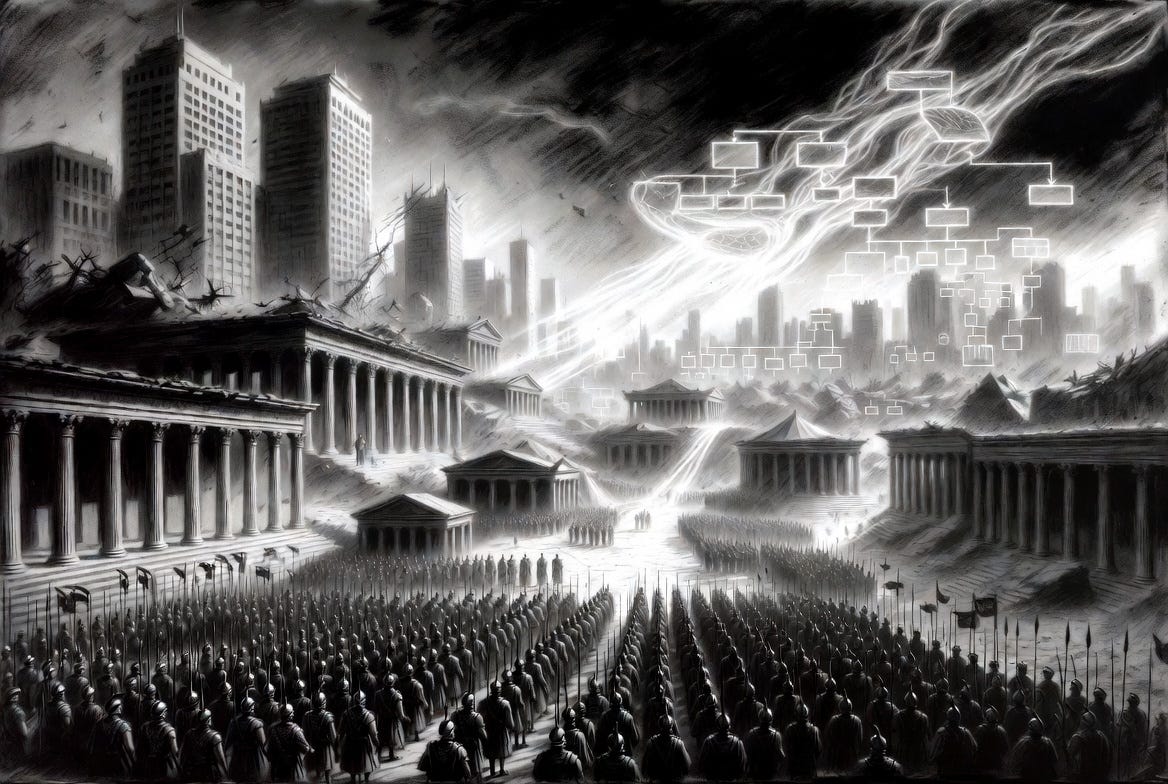
The Roman Army figured this out two thousand years ago. Eight soldiers shared a tent under a decanus. Ten of those units formed a century under a centurion. Six centuries made a cohort. Ten cohorts made a legion. At every layer, a named commander held defined authority, aggregated information from below, and relayed decisions from above. The structure, 8 to 80 to 480 to 5,000, was not a management philosophy. It was an information routing protocol built around a single human limitation: a leader can effectively manage somewhere between three and eight people. The Romans discovered this through centuries of warfare. The U.S. Army still follows the same pattern today. We call it “span of control,” and it remains the governing constraint of every large organization on earth.
Jack Dorsey and Roelof Botha laid this history out in a recent piece for Block, tracing the line from Roman legions through Prussian military reform, American railroads, Frederick Taylor’s scientific management, and the Manhattan Project, all the way to the modern corporate org chart. Their argument is striking: for two thousand years, every innovation in organizational design has been an attempt to work around the same fundamental tradeoff. Narrowing span of control means adding layers. More layers mean slower information flow. And slower information flow means slower decisions, which means slower adaptation, which, in a volatile environment, means death.
Here’s what caught my attention, and what I think most readers will miss: the Block piece is not really about Block. It is about the fact that the foundational assumption beneath nearly every institution in the modern world, the assumption that humans must be the coordination mechanism in complex systems, is no longer necessarily true.
Think about that for a moment.
The Hierarchy You Don’t See
Most people, when they hear the word “hierarchy,” think of org charts and corner offices. That is the visible hierarchy, the one we can point to and critique. But there is a deeper hierarchy that operates beneath conscious awareness, and it shapes far more than corporate structure.
Our educational system is hierarchical. Not just in the obvious sense that there are teachers and students, principals and superintendents. The entire epistemological framework, the way we decide what counts as knowledge, who is qualified to transmit it, and how competence is credentialed, is built on a hierarchical model that dates to the medieval university. You sit in a room. An authority figure lectures. You demonstrate retention. You receive a credential. That credential signals to future hierarchies (employers, professional bodies, licensing boards) that you have been processed through the correct layers. The knowledge itself is almost secondary to the routing.
Our economic systems are hierarchical. Capital flows through layers of intermediation: central banks to commercial banks to regional lenders to borrowers. Information about creditworthiness travels up through those same layers, gets processed, and decisions travel back down. I see this every day at B:Side. The distance between a small business owner’s reality and the decision that determines whether they get funded is measured in layers. Each layer adds latency. Each layer adds friction. Each layer adds cost. And each layer, however well-intentioned, introduces the possibility of distortion.
Our political systems are hierarchical. Representative democracy itself is a hierarchical information routing protocol. Citizens transmit preferences to local representatives, who aggregate and relay them to higher bodies, who synthesize them into policy. The system was designed for an era when direct communication across large populations was physically impossible. The layers existed because they had to.
Even our mental models are hierarchical. We think in categories that nest inside larger categories. We evaluate ideas by checking them against authorities. We process information by routing it through frameworks we learned from people above us in some knowledge hierarchy. The way most people reason about the world, the way they evaluate what is true and what matters, is itself a product of hierarchical conditioning.
This is what I mean when I say the architecture is invisible. It is not just how we organize. It is how we think.
The Entrepreneurial Exception
Entrepreneurs have always been the exception to this pattern, even if they could not always articulate why.
The defining characteristic of the entrepreneurial mind is not risk tolerance or creativity or vision, though those matter. It is the instinct to route around hierarchy. When an entrepreneur looks at a problem, they do not ask, “What does the existing structure say about how to solve this?” They ask, “What is the fastest, smartest, most frictionless way to solve this?” Those are fundamentally different questions, and they produce fundamentally different answers.
I built BodeTree on this instinct. The financial services industry had layers upon layers of intermediation between small business owners and the financial intelligence they needed to make good decisions. Banks had the data. Accountants had the expertise. Software companies had the tools. But the small business owner, the person who actually needed the insight, was at the bottom of every one of those hierarchies, waiting for information to trickle down through layers that each extracted value along the way. BodeTree’s entire premise was: what if we just connected the business owner directly to the insight?
That sounds obvious in retrospect. Most entrepreneurial insights do. But at the time, the idea that you could bypass the established hierarchy of financial intermediation was treated as somewhere between naive and dangerous. The layers existed for a reason, we were told. The complexity required expertise. The expertise required credentials. The credentials required institutions. The institutions required hierarchy.
Every entrepreneur has heard some version of this argument. Every entrepreneur who succeeded did so by proving it wrong, at least in one specific domain.
But here is what is different about this moment: the entrepreneurial instinct to route around hierarchy is no longer a personality trait or a business strategy. It is becoming a survival requirement. And it is not just about business anymore. It is about everything.
The Convergence
Two forces are converging right now that make the hierarchical foundation of our systems not just suboptimal but actively dangerous.
The first is artificial intelligence. The Block piece makes this case compellingly. For the first time in human history, we have a technology that can actually perform the coordination functions that hierarchy exists to provide. A system can maintain a continuously updated model of an entire operation and use it to coordinate work in ways that previously required humans relaying information through layers of management. The information routing problem that the Romans solved with centurions and the railroads solved with org charts and McKinsey solved with matrix structures can now, at least in principle, be solved by intelligence itself.
Block is building what they call a “company world model,” a continuously updated representation of everything happening across the organization, and a “customer world model” built from proprietary transaction data. Together, these form the foundation for what they describe as a company organized as an intelligence rather than a hierarchy. Instead of managers routing information up and down chains of command, the system maintains the picture. People operate at the edge, where the intelligence makes contact with reality.
This is not speculative. Block is reorganizing around three roles: individual contributors who build and operate systems, Directly Responsible Individuals who own cross-cutting problems, and player-coaches who combine building with developing people. There is no permanent middle management layer. The system handles alignment. The people handle craft, judgment, and the things the model cannot yet perceive: intuition, cultural context, trust dynamics, the feeling in a room.
The second force is the Fourth Turning itself.
I write about Fourth Turnings often in this newsletter because I believe the Strauss-Howe framework is the most honest description of the era we are living through. Fourth Turnings are periods when the institutional order that was built during the previous cycle reaches the end of its structural life. The institutions do not just need reform. They need replacement. The assumptions that undergirded them, assumptions that were so deeply embedded they felt like natural law, are revealed to be contingent, historical, and increasingly dysfunctional.
Hierarchy is one of those assumptions.
The institutional hierarchies that governed the postwar order, corporate, educational, political, financial, were not designed for a world of abundant information, instant communication, and artificial intelligence. They were designed for a world of scarce information, slow communication, and human-only coordination. The entire architecture was a response to constraint. Remove the constraint, and the architecture does not just become unnecessary. It becomes an active impediment.
This is what Fourth Turnings do. They expose the gap between the world as it actually is and the world as our inherited institutions assume it to be. And when that gap gets wide enough, the old architecture does not adapt. It breaks.
The Entrepreneurial Imperative
This convergence, AI plus Fourth Turning, creates what I would call the entrepreneurial imperative. It is no longer sufficient to be entrepreneurial in business. You must be entrepreneurial in everything.
What does that mean in practice? It means applying the core entrepreneurial question, “What is the fastest, smartest, most frictionless way to do this?”, to every domain of your life and work. Not as an optimization exercise, but as a fundamental rethinking of first principles.
In how you learn.
The hierarchical model of education, where an authority transmits knowledge to a passive recipient who demonstrates retention, is collapsing. Not because teachers are bad or schools are broken (though some are), but because the information routing problem that the model was designed to solve has been solved by other means. You can now access the world’s knowledge directly, interrogate it interactively, and apply it immediately. The entrepreneurial question is not “How do I get into the best program?” It is “What is the fastest path to genuine competence in the thing I need to know?”
In how you work.
The Block model is instructive here, even if you do not work at a technology company. The principle is the same across industries: identify the coordination functions that hierarchy performs in your organization, and ask honestly whether a human chain of command is still the best way to perform them. In many cases, it is not. The information that used to require three layers of management to synthesize and relay can now be synthesized and relayed by a system. The question is whether your organization has the courage to act on that reality, or whether it will cling to the old architecture because it is familiar.
In how you make decisions.
Hierarchical decision-making is inherently slow because it routes choices through layers of approval. In a stable environment, that slowness is a feature: it prevents rash action and ensures alignment. In a volatile environment, it is a liability. The entrepreneurial approach to decisions is not recklessness. It is the elimination of unnecessary intermediation between information and action. See the situation clearly, decide, act, learn, adjust. The people and organizations that can compress that cycle will outperform those that cannot.
In how you build institutions.
This is perhaps the most important and least understood implication. We are not just optimizing existing institutions. We are in a period where new institutions must be designed from scratch, and those institutions should not inherit the hierarchical assumptions of the ones they replace. Block’s model, where the intelligence lives in the system and the people operate at the edge, is one template. It will not be the only one. But the principle, design for intelligence rather than hierarchy, should inform how we build everything from companies to schools to civic organizations.
What This Means for You
I see this from two vantage points, as I often do.
As CEO of B:Side, I see the competitive reality. The companies that figure out how to organize around intelligence rather than hierarchy will move faster, serve customers better, and attract better talent. The companies that cling to hierarchical coordination because it is comfortable will find themselves increasingly unable to compete. This is not a prediction about the distant future. It is happening now. Block is already reorganizing. Others will follow. If your organization is not asking these questions, you are already behind.
As a professor at ASU, I see the human reality. I look at my students and I know that the hierarchical career ladder many of them are planning to climb, the one where you enter at the bottom, prove yourself through layers of increasingly senior roles, and eventually reach a position of authority, is evaporating. Not because ambition is dead, but because the layers themselves are disappearing. The students who will thrive are the ones who develop the entrepreneurial instinct: the ability to route around hierarchy, to connect directly with problems and solve them, to build competence that does not depend on institutional validation.
If you are currently leading an organization, the most important thing you can do right now is audit your hierarchy honestly. Not the org chart on the wall, but the actual information flows. Where does knowledge get created? How many layers does it pass through before it reaches a decision-maker? How much latency does each layer add? How much distortion? For each layer, ask: is a human chain of command still the best way to perform this coordination function, or could it be done faster and more accurately by a system? You will not like all the answers. Act on them anyway.
If you are building something new, whether a company or a team or a curriculum or a community, resist the instinct to replicate the hierarchical structures you grew up in. They feel natural because they are familiar, not because they are right. Start instead from the entrepreneurial question: what is the fastest, smartest, most frictionless way to achieve the outcome we are after? Build the lightest possible structure that can support that answer, and be willing to rebuild it as the answer changes.
If you are early in your career or still in school, understand that the most valuable skill you can develop is not expertise within a hierarchy but the ability to operate without one. Learn to find information directly rather than waiting for it to be transmitted to you through layers. Learn to make decisions with imperfect information rather than routing every choice through an approval chain. Learn to create value at the edge, where intelligence meets reality, rather than aspiring to a position in a middle layer that may not exist by the time you get there.
The Architecture Beneath the Architecture
We are living through a moment when the invisible becomes visible. The hierarchical architecture that has organized human activity for two thousand years, from Roman legions to corporate org charts, from medieval universities to modern school systems, from monarchies to representative democracies, is being exposed for what it always was: a solution to a specific set of constraints that are rapidly disappearing.
This does not mean hierarchy vanishes overnight. The Romans did not build their system because they were stupid. They built it because it was the best available solution to a real problem. And for two millennia, it remained the best available solution. What has changed is not the problem but the set of available solutions. For the first time, we have technology capable of performing the coordination functions that hierarchy exists to provide. That changes everything.
The entrepreneurial mind has always sensed this, even before the tools existed to act on it fully. The instinct to route around, to find the smartest and fastest path, to question structural assumptions that everyone else takes for granted: that instinct is no longer a competitive advantage for founders and startups. It is the baseline requirement for anyone who wants to remain relevant in a world that is being reorganized around intelligence rather than authority.
In a Fourth Turning, the old architecture does not get renovated. It gets replaced. The question is not whether this shift will happen. It is whether you will be the one building the new architecture or the one standing in the rubble of the old.
The hierarchy served us well. It is time to build what comes next.