


The bond market is doing the job no other institution in American public life is willing to do. It is telling the government no.
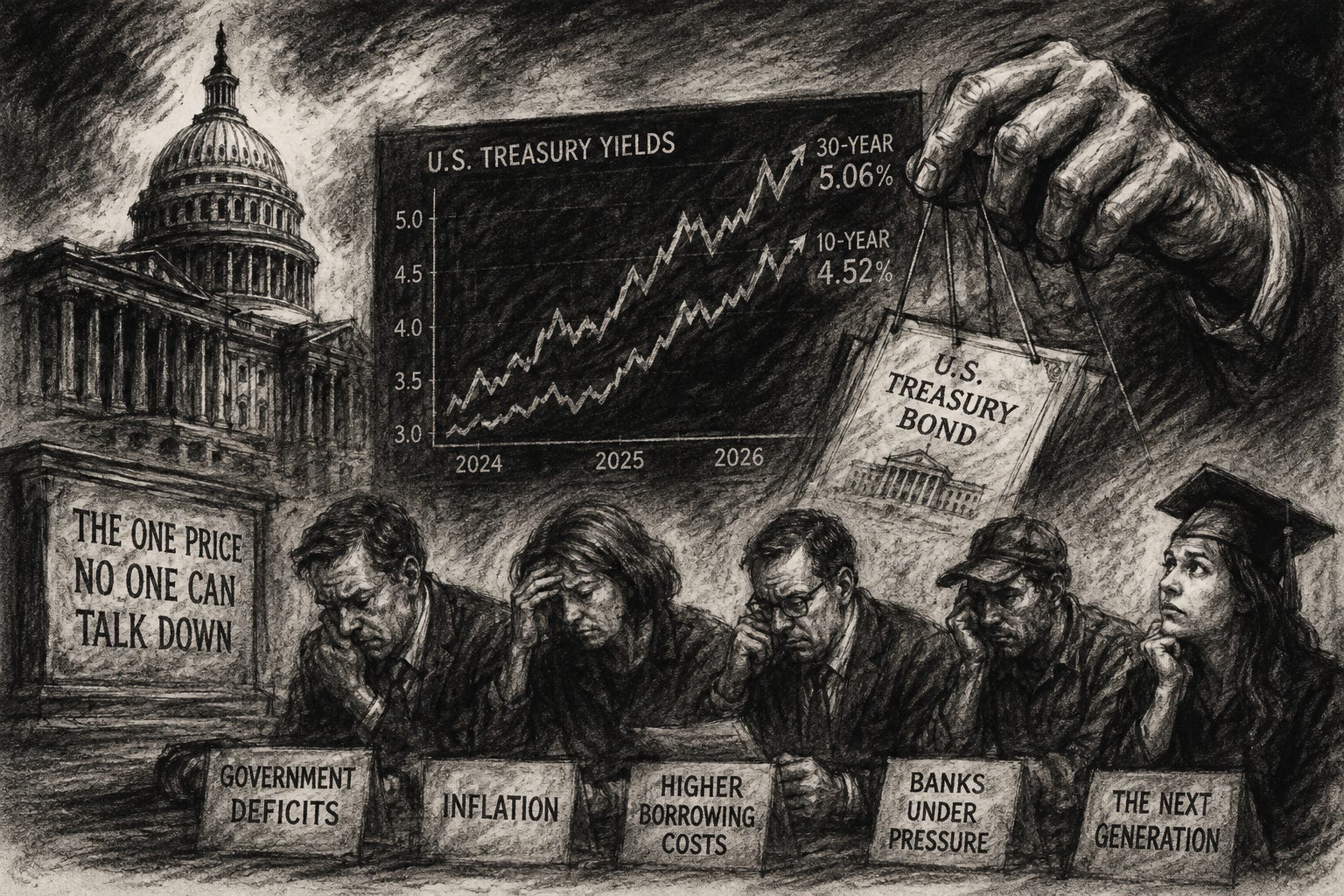
Every other check on executive power has been worn down, captured, or worked around. The yield curve has not. It is the one price in the American economy that cannot be lobbied, regulated, jawboned, or politically captured for very long. The rate at which the federal government can borrow money for ten years is whatever the people buying that paper say it is, and nothing else. For most of the last fifteen years, that authority sat dormant. Quantitative easing kept a permanent buyer in the market. Zero rates erased the cost of holding cash. A long disinflationary trend let everyone, governments and households and corporations alike, operate as if discipline was a stylistic preference.
The authority was dormant, not gone. It was waiting for conditions that would summon it back. Those conditions have arrived.
The Dress Rehearsal
In April 2025, a sitting president unveiled the most aggressive set of tariffs in nearly a century. The policy was popular with his base. It was framed as a long-overdue rebalancing of the global trading system. Whatever you thought of it on the merits, it had the political cover to survive any normal kind of opposition.
It did not survive the bond market.
In the days following the announcement, the ten-year Treasury yield surged toward and above 4.5 percent. The thirty-year moved with it. Mortgage rates spiked. Credit spreads widened. The dollar wobbled. The administration had calculated for political resistance and gotten something else entirely. Foreign holders of Treasuries were quietly reassessing their willingness to fund American deficits at prevailing prices. Domestic investors were demanding more compensation to hold long-duration risk. The math on borrowing 30 trillion dollars at five percent and rising was reasserting itself faster than the policy could absorb.
Inside of ninety days, the tariff regime was largely paused. Congress had nothing to do with the reversal. The courts had nothing to do with it. Public opinion had not turned. The administration backed down because the cost of carry on the federal balance sheet became politically unbearable, and the only force in the country that could deliver that message in a way the administration had to listen to was the long end of the Treasury curve.
That episode should have been studied harder than it was. It was a clean demonstration of how the discipline gets imposed when no one inside the system is willing to impose it on themselves.
The same market is back at the door.
What Just Happened
On May 15, 2026, the ten-year yield broke above 4.5 percent for the first time since June of last year, trading at 4.52. The thirty-year cleared 5 percent and kept going, settling at 5.06. The two-year moved with them. Thirty-year mortgage rates moved back into the mid-6s, with market quotes suggesting further pressure if the 10-year Treasury keeps rising. The April CPI print came in at 3.8 percent year over year, the hottest reading in three years, with energy prices accounting for more than 40 percent of the monthly increase.
The yield curve did all of this in a few sessions, without a Fed meeting, without a press conference, without anyone in Washington signing off on the move.
The new Federal Reserve Chair, Kevin Warsh, was confirmed by the Senate two days before the spike. He inherits an environment that has already moved past him. The market is repricing in real time on its own assessment of inflation persistence, fiscal sustainability, and the credibility of the central bank under new leadership. The era of waiting for Fed guidance to set the tone is over. The market is moving first, and the central bank is being asked to catch up.
The base case for most of late 2025 was that the Fed would resume cutting in 2026. That base case is gone. Markets are now pricing a meaningful probability of a hike before the end of the year. Higher for longer is the consensus again, and the trigger for the repricing came from the market itself.
That distinction matters more than anything else in this piece. There is no pivot to wait for. The standard playbook for the post-2008 era assumed the Fed would always blink first. That assumption is being retired in front of us.
Why the Discipline Returned
There is an old line from James Carville, when he was advising the Clinton administration, that if he came back in another life he wanted to be the bond market because it could intimidate everybody. He was not exaggerating. He was describing what it felt like to watch every major policy decision get filtered through the question of whether the long end would tolerate it.
Three forces are now reinforcing each other to produce a regime in which that intimidation is back.
The first is supply-side inflation. The conflict in the Middle East has kept the Strait of Hormuz a live geopolitical wound, and the energy price shock has flowed through to nearly every category of the consumer price index. The Fed cannot drill for oil. Monetary policy can lean against demand, but it has no instrument for a sustained supply shock. Until the geopolitical picture changes materially, energy will keep feeding the inflation print, and the bond market will keep pricing that reality into duration.
The second is fiscal weight. Federal debt has crossed 39 trillion dollars. The last time the ten-year yield was at current levels, in 2007, total debt was nine trillion. The math on servicing 39 trillion at five percent and above is the kind of math that quietly forces a term premium back into long bonds. Investors are demanding more compensation to hold the long end because the arithmetic has stopped working at any other price.
The third is the credibility transition at the Fed itself. A new chair inheriting a regime change is being asked to demonstrate, quickly, that he understands what the market is telling him. The market is pricing that uncertainty into the curve and letting the new chair respond.
The thread running through all of this is the same thread that ran through the original Carville era. When leaders, governments, and institutions refuse to impose discipline on themselves, the market eventually imposes it on them. The form that discipline takes is almost never the form anyone would have chosen.
The bond market sets the price. Everyone else accepts it.
What the View From the Credit Side Looks Like
Running a small business lending operation through the last twelve months has been an exercise in watching a regime change happen at the underwriting level before it shows up in the headlines.
The 504 product is directly tied to the five- and ten-year Treasury. A deal that penciled at five and a half percent eighteen months ago does not pencil at seven. Refinance walls that looked manageable in late 2025 are no longer manageable, and the conversations we are having with borrowers about how to restructure those obligations have a different quality to them than they did even six months ago. The math has changed underneath people, and the people who are doing well are the ones who recognized it early.
Aggregate unrealized losses had eased through late 2025, but the renewed rise in long rates threatens to rebuild the same balance sheet pressure that made 2023 so dangerous. The mechanism is the same. The trigger is different in a way that should make every bank executive pay attention. SVB broke because the Fed was tightening into a portfolio mismatch. This time the Fed is not doing anything. The market is repricing on its own authority, and the duration risk is showing up in bank books regardless of what the central bank chooses to do. Credit standards are tightening again, though the public Fed survey still describes the move as modest rather than severe. The loan officers I talk to are watching the data carefully and beginning to prepare their clients for what continued pressure would feel like.
The other view comes from the classroom. The class of 2026 is walking onto the floor of an economy where capital costs something for the first time in their adult lives. The assumptions about career-building they inherited from their professors and their parents were almost entirely downstream of zero rates. Leverage up. Optimize for growth. Worry about profitability later. Those assumptions had a shelf life, and the shelf life has expired.
I cannot honestly tell those students to plan for a return to the world that produced their playbook. That world is not coming back on a timeline that helps them. The graduates who will do well in this decade are the ones who internalize early that capital costs money, that discipline is the price of staying solvent, and that the asset price regime of the 2010s was the anomaly. The conditions we are entering are the longer-running norm.
Both of those things are true at the same time. I underwrite the new regime without flinching, and I tell the next cohort that the rules they were taught do not describe the world they are about to enter.
The Playbook
For leaders facing this regime, the work has a sequence.
Model your business at a sustained 7.5 percent borrowing cost for the next two years, and treat that number as the base case rather than a stress test. If the unit economics survive at that cost of capital, you have time to make adjustments deliberately. If they do not, the changes you need to make are best made now, while the timeline is yours, rather than in the fourth quarter when the bank calls and the schedule belongs to someone else.
Tighten the strategic plan. The cost of indulgent decisions on headcount, capex, and compensation just went up. The leaders I respect most are quietly resizing their plans now, before the board meeting that would have forced the issue. Discipline imposed early looks like prudence. Discipline imposed late looks like panic.
Build cash. The institutions and the businesses that come through this cycle intact will be the ones that resisted the temptation to chase yield with their balance sheets and resisted the parallel temptation to chase growth with their operating plans. Liquidity is option value, and option value in this regime is worth more than it has been worth in a decade.
Pay attention to pricing power. The businesses that survive a higher-for-longer environment with persistent inflation are the ones whose customers cannot easily walk away. If your competitive position depends on undercutting price in a market with rising input costs, the math is going to catch you. Understand where you have genuine pricing power and where you do not, and operate accordingly.
Stop waiting for the rescue. The Fed cannot cut its way out of an inflation print that is being driven by an energy shock and a fiscal trajectory. Warsh will not deliver a pivot that contradicts what the bond market is telling him to do. The rescue most people are imagining does not exist in this regime. The leaders who recognize that early will have time to operate. The ones who keep waiting will operate from a worse position every quarter.
The Reckoning
The bond market is asking the same question it asked in April of last year. Are you serious about the math, or are you not?
A press release will not be enough of an answer. A speech will not be enough. The answer has to be behavior, and the behavior has to start before the situation gets meaningfully worse.
Discipline imposed from outside is always more painful than discipline imposed from within. It is still discipline. It still works. The businesses, the banks, and the leaders who internalize this now will move into the next phase of the cycle with their footing intact. The ones who keep rationalizing will be moved against their will, on someone else’s schedule, at a cost they did not choose.
The market has reasserted itself. The cost of pretending otherwise is rising every day. The leaders who understand this are already adjusting. Quietly. Without announcement. Before the moment forces them to.
The discipline the bond market is now imposing from the outside is the same discipline the strongest leaders learn to impose from within. The leadership modes that hold up when capital stops being cheap and markets stop being patient are profiled in Honor Under Pressure, Book One of The Fourth Turning Leader series. Interactive tools for building that capacity, including the Bright Line Test, the Midnight Test, and the Compromise Calculus, are available at www.thefourthturningleader.com.