


I just landed in Washington for Congressional meetings, and on my walk over from the hotel this morning I realized my room is on the same block as Ford’s Theater. Lincoln has been on my mind for weeks anyway. He features prominently in Honor Under Pressure, and the book is recent enough that I see him in everything right now. But the bigger reason he is front and center has less to do with the theater than with the city itself.
The chaos of this place is on full display. Negotiations are on, then off, then on again by lunchtime. Decisions made at 10 a.m. get reversed by 3 p.m. Staff members who spoke confidently before lunch carry visibly different orders by dinner. The whiplash is the work. And it raised a question that travels with me when I leave Washington. How do the people one level down from chaotic leadership do their jobs, hold their values, and come through the experience intact?
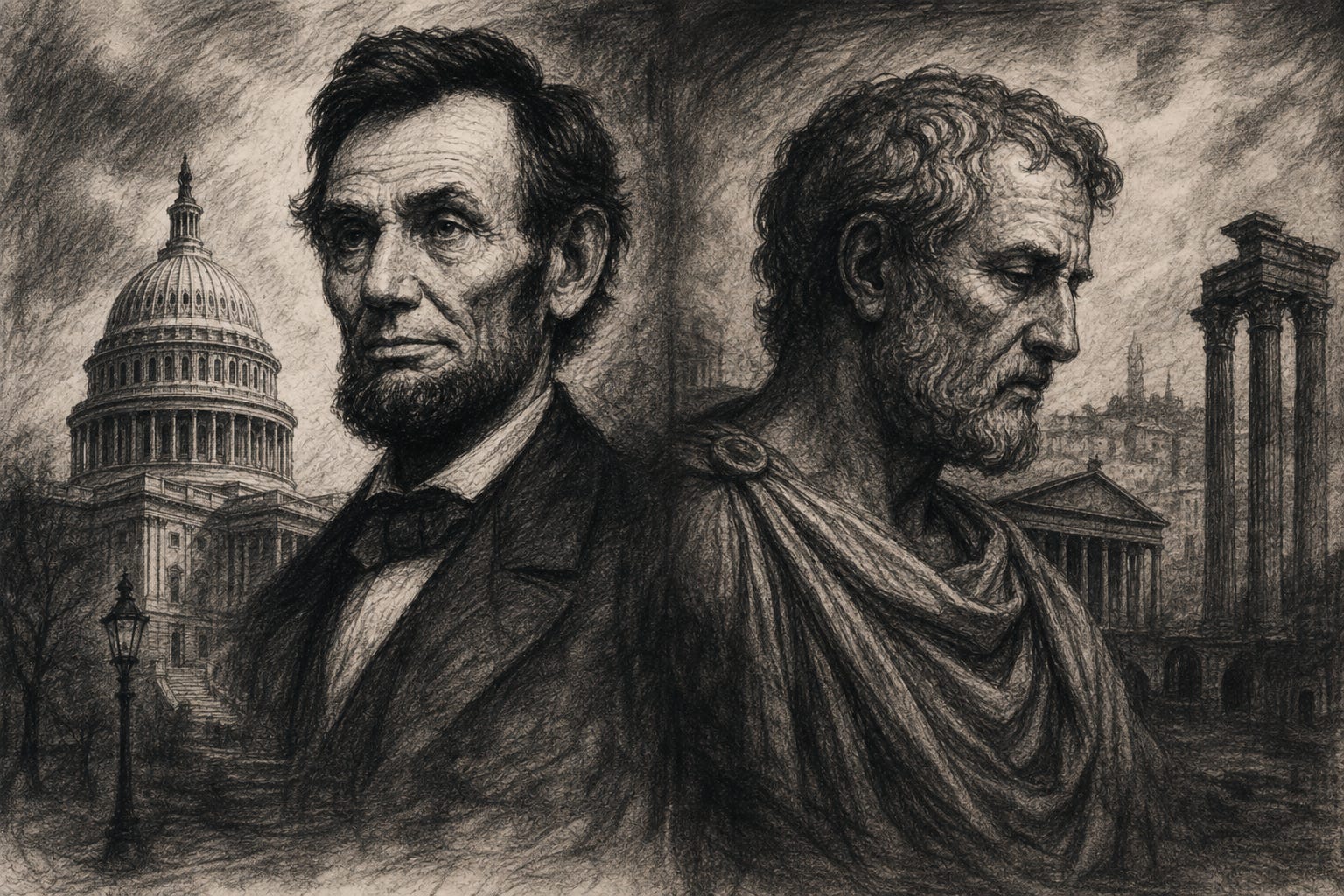
Lincoln offers one answer, and it is the easy one. He was, by every reliable account, exhausting to work for. He wandered into other people’s meetings. He told stories at the wrong moments. He reversed himself on military strategy with maddening regularity. The men around him absorbed his volatility because the substance underneath was sound. They trusted where he was going even when they could not predict the route.
That is the easy version of the problem.
The harder version is what made me start writing this. Most leaders who serve chaotic masters face something worse than what Lincoln’s cabinet faced. They are serving someone whose substance they are no longer sure about. The chaos is real, but so is the doubt. And every day they stay, they wonder whether their presence is moderating the damage or legitimizing it.
That question has a name. It is the proximity paradox, and it has been around as long as power has had advisors.
Seneca and Nero
Seneca spent the back half of his life inside that question. He served Nero as tutor and chief advisor through some of Rome’s most volatile years. He used his proximity to moderate the emperor’s worst instincts. He drafted speeches that bought the empire stability. He counseled restraint when restraint was unfashionable. And he watched, slowly, as his presence became something other than what he had intended.
This is the structure of the trap. Influence and complicity grow together. The longer you stay close to chaotic power, the more capable you become of shaping it, and the more responsible you become for what it does. The skills you develop to remain effective are the same skills that produce your complicity. You learn to read moods. You learn which battles to fight on which days. You learn to write the version of the order that does the least damage. You become, over time, indispensable to a system you would never have chosen to build.
Seneca’s letters from those years are remarkable for what they reveal about a man trying to hold the line internally while losing it externally. He kept his philosophy. He maintained correspondence with people who knew him before the imperial court. He told himself the work mattered. And by the time he understood that his moderation had hardened into rationalization, he had no clean exit. Nero forced his suicide in the end. The historical irony writes itself.
The proximity paradox is what Seneca lived. It is what Honor Under Pressure calls the rationalization warning, and it is the leadership shadow that haunts every advisor, deputy, chief of staff, partner, and trusted lieutenant in a volatile organization. Every leader will encounter it sooner or later. The real work is seeing the transition point before it has passed.
Why This Comes Up Now
We are in a period of institutional strain that Neil Howe correctly identifies as a Fourth Turning. In Fourth Turnings, the old structures stop holding their shape. Volatile leadership stops being the exception and becomes a feature of the landscape. Economic uncertainty, technological disruption, and social fragmentation create conditions where the people at the top operate under stress they cannot fully manage, and the people one level down are left to absorb the consequences.
This dynamic runs far beyond politics. It shows up in corporate boards, family businesses, professional partnerships, military commands, and nonprofit leadership. Almost every leader I know is currently managing upward to at least one principal whose judgment under pressure has become unreliable. The honest ones admit it. The rest are still telling themselves a story.
The Compromise Calculus from Honor Under Pressure applies directly here. Every accommodation has a price. The question is whether you are tracking the price honestly, or whether you have started discounting it because the work feels too important to leave.
The Transition Points
Strategic patience and moral surrender look identical from the inside. That is the central difficulty. You cannot rely on how you feel to tell you which one you are practicing, because the feelings are the same. You feel useful. You feel necessary. You feel that the alternative to your presence is worse than your presence. These feelings are accurate right up to the moment they stop being accurate, and they do not announce the shift.
The Bright Line Test exists for this reason. You decide in advance, in calmer hours, what you will not do and what you will not enable. You write it down. You tell it to at least one person who is not in the situation with you. The line is a commitment drawn in clear weather and held when the weather turns.
The Midnight Test sits next to the Bright Line. At three in the morning, when the rationalizations go quiet and the day’s pressures recede, what does the work look like from outside? Would the person who took this position five years ago recognize the person doing it now? Would they be proud, or would they be quietly horrified?
These tests are uncomfortable by design. They exist to interrupt the slow drift that the proximity paradox produces. Seneca, by all evidence, stopped doing some version of them. He told himself the next compromise would be the last one, and then the next one, and then he was out of moves. Most people who get trapped get trapped this way, through two hundred small decisions that no single test could have caught in isolation.
The Grant Counterweight
There is another way to navigate proximity to power, and it is worth holding alongside the Seneca example. Ulysses S. Grant served Lincoln through some of the worst conditions any American commander has ever faced. He absorbed Lincoln’s chaos, translated his shifting instructions into coherent action, and earned the autonomy he eventually had by producing outcomes nobody else could produce.
What protected Grant was the clarity of the mission and the alignment of the values. He was winning a war whose object he believed in. The measuring stick was external. He did not need to interpret Lincoln’s moods to know whether he was doing the right work, because the work spoke for itself. Battles were won or lost. Armies advanced or did not. The volatility of his principal was real, but it did not contaminate his sense of direction.
Grant’s example matters because it tells you what the Seneca trap requires to develop. It requires moral ambiguity in the underlying mission. When the mission is clear and the values align, proximity to a difficult leader is sustainable, even productive. When the mission is muddy and the values are drifting, proximity becomes the slow erosion that Seneca lived. The first diagnostic question to ask yourself concerns the mission you are part of, and whether you can still see it cleanly. The leader you serve is a secondary consideration.
External Accountability
Proximity produces a specific kind of cognitive distortion. The longer you serve someone, the more invested you become in making the relationship work, and the more sophisticated your rationalizations become. This is psychological adaptation. The brain adjusts to its environment, and the environment around volatile power is constant low-grade emergency.
The only reliable correction is external. You need people who knew you before this job, who do not depend on your continued presence in it, and who are willing to ask uncomfortable questions when your answers start to drift. Seneca tried to maintain this through his correspondence, and his letters survive partly because he was using them to hold himself accountable. The fact that he ultimately failed does not invalidate the method. It tells you what the method has to be: regular, structured, and immune to your own justifications.
Mentors who profit from your rise become a chorus over time. The check has to come from somewhere quieter, from people whose stake in the truth is greater than their stake in your career. Give that voice real weight when it speaks, especially when what it says is inconvenient.
A Working Framework
If you are inside the proximity paradox right now, the practical work breaks into five pieces.
First, identify three people who knew your principles before you took this position. Establish a regular cadence with them. They serve as mirrors. They reflect back whether your current decisions match the values you told them you held.
Second, run the Fresh Eyes Test on a monthly schedule. Imagine someone with your stated principles walking into your situation today, without your accumulated context. What would they conclude? If the gap between their conclusion and your current behavior is widening, you are approaching a transition point whether you feel it or not.
Third, track the ratio of influence to complicity. Keep a simple record. For each significant decision, note whether your presence moved the outcome toward your values or away from them. If the answer has been consistently negative for six months, the moderation argument has stopped holding.
Fourth, preserve independent capability. The moment you cannot afford to leave is the moment your judgment becomes compromised. Keep your skills current. Keep your network alive. Keep your finances in a shape that lets you walk if you need to. Optionality is the structural condition that lets honest judgment survive.
Fifth, write down three things you will not do under any circumstance. Review the list every quarter. If you find yourself revising it to accommodate recent decisions rather than to guide future ones, you have your answer.
Don’t Wait Too Long
Seneca’s tragedy was the waiting. He stayed too long, hoping for conditions that were never going to improve, and his presence at the end was legitimizing outcomes he could no longer defend. The historical record gives us his death and his letters. It gives us a man who understood the proximity paradox better than almost anyone and still got caught by it.
The leaders who navigate this terrain successfully share two things. They build external accountability before they need it, and they draw bright lines they have told someone else about. They know what they will not do, and they have arranged their lives to allow them to walk away when the line gets crossed.
That is the discipline this moment calls for. The chaos at the top is not slowing down. The volatility is becoming a permanent feature of the working landscape. What you can control is whether you stay honest about the trade-offs you are making, and whether the people qualified to judge that honesty have the access they need to do it.
The work is to be the lieutenant who can leave. Everything else follows.
Seneca’s rationalization warning is one of five leadership modes profiled in Honor Under Pressure, Book One of The Fourth Turning Leader series. Interactive tools for working through your own version of the proximity paradox — including the Bright Line Test, the Midnight Test, and the Compromise Calculus — are available at www.thefourthturningleader.com.