


When two great powers tell themselves the conflict is inevitable, they tend to produce it. The leaders who break the pattern do it deliberately.
The dangerous thing about historical inevitability is that the people who believe in it tend to produce it.
Every great power conflict in modern history began with at least one side, often both, convinced that war was coming whether they wanted it or not. The conviction shaped the preparation. The preparation shaped the incentives. The incentives shaped the choices. By the time the actual decision arrived, it had stopped feeling like a decision and started feeling like the completion of a script that everyone had been writing for years.
This is the structural problem with calling something a trap. The word implies fate, an outside force closing in. The reality runs in the other direction. The trap is built from the inside, slowly, by leaders who keep telling themselves the outcome is being forced on them while making the choices that force it. Calling something inevitable is half the work of making it so.
This week in Beijing, Xi Jinping said the words out loud.
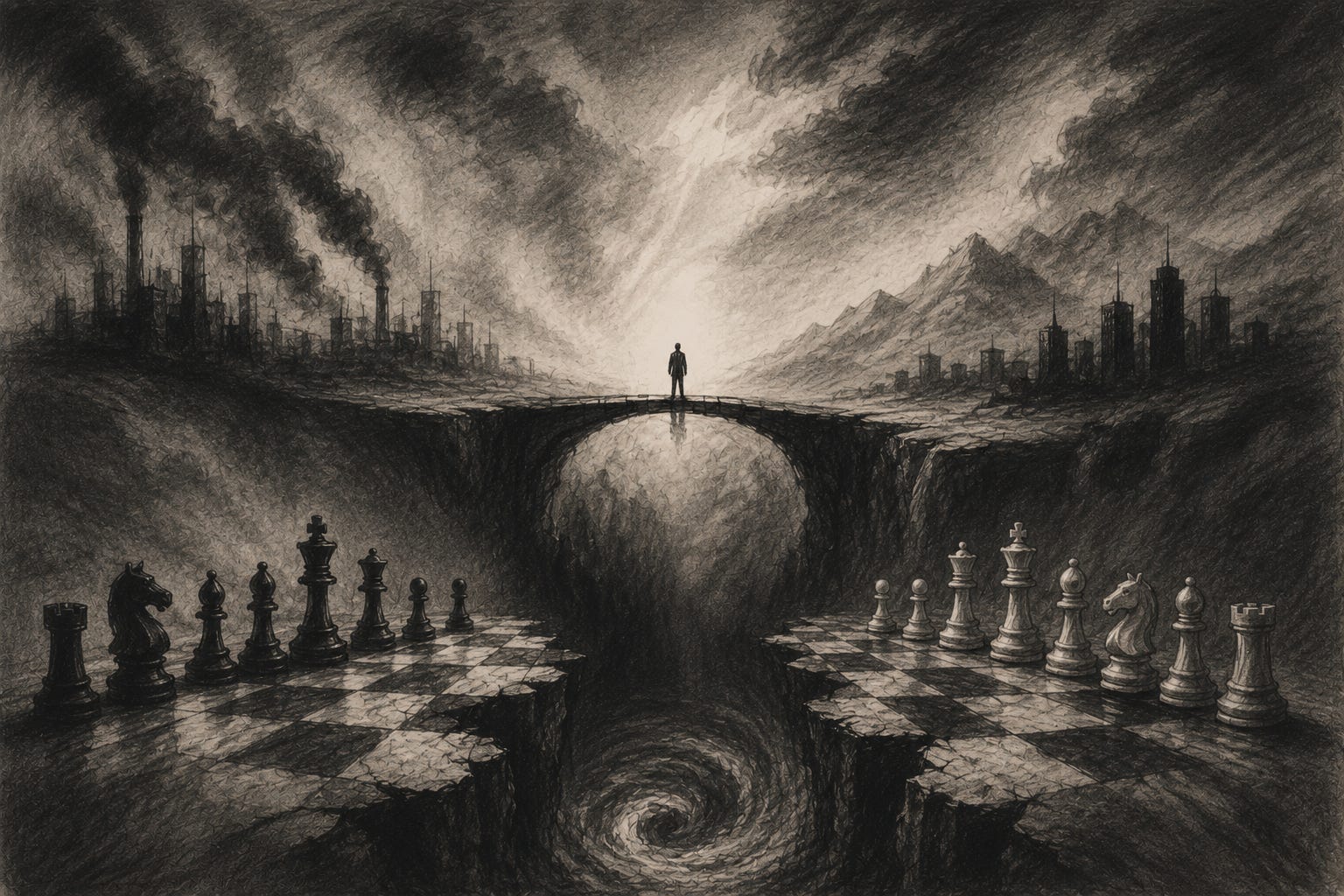
What Xi Said
At the May 14 summit with President Trump in the Great Hall of the People, Xi opened with a direct question. “The world has come to a new crossroads. Can China and the United States transcend the so-called ‘Thucydides Trap’ and forge a new paradigm for major-power relations?”
He went on to frame the answer in language that has become characteristic of his recent diplomacy. The trap is a test of strategic choices rather than a verdict of fate. Mishandled, the rivalry could “collide or even come into conflict, pushing the entire China-US relationship into a highly perilous situation.” Handled well, the rejuvenation of China and the renewal of America could go forward together. The choice, in his framing, belonged to leadership.
Whatever you think of Xi as a leader or China as a strategic competitor, the choice of phrase was deliberate. He has used the Thucydides reference before, in 2015 and again in 2023, always to make the same structural point. The pattern is downstream of leaders failing to see clearly and acting on assumptions that the rivalry forces on them. He is signaling that he understands the framework, and inviting the other side to choose with him.
That this came against the backdrop of last year’s tariff war made the framing land differently. 2025 was not an abstraction. U.S. tariffs on Chinese goods reached as high as 145 percent on key categories. China retaliated with tariffs up to 125 percent and restrictions on rare-earth exports that rattled global supply chains. Bilateral trade collapsed by more than a quarter. American farmers lost their soybean market. American manufacturers absorbed input cost shocks. Chinese exporters watched their access to the largest consumer market in the world compress. The October truce in Busan paused the escalation. The May summit arrived as that truce neared expiration.
Both sides had spent a year operating inside the script. Both sides arrived in Beijing with the costs visible on their respective balance sheets.
The Pattern Allison Found
The Thucydides Trap as a concept was popularized by Harvard’s Graham Allison, drawing on the Greek historian’s account of why Athens and Sparta went to war in the fifth century BC. Thucydides wrote that “it was the rise of Athens and the fear that this instilled in Sparta that made war inevitable.” Allison set out to test that observation against the historical record. He looked at sixteen cases over five centuries in which a rising power challenged an established one. Twelve ended in war. Four did not.
The twelve are the cases everyone remembers. Spain against the Dutch in the seventeenth century. France against the Habsburgs. Germany against Britain twice in the twentieth century. Japan against the United States. The list is long enough to do the rhetorical work the framework is designed to do, which is to make the inevitability feel earned.
The four exceptions are the more interesting cases. Spain and Portugal divided the new world by treaty in 1494 rather than going to war over it. The United States surpassed Britain as the dominant global power across the late nineteenth and early twentieth centuries without an Anglo-American war. The Soviet Union and the United States competed for forty years and came closer to nuclear war than most observers realized, but they never actually fought one. Germany’s reunification at the end of the Cold War shifted European power without producing the kind of continental conflict the previous two such shifts had produced.
The cases that avoided war had different specifics, but they shared certain conditions. The incumbent power was willing to accept some loss of relative position rather than fight to preserve it. The rising power was careful not to humiliate the incumbent. Both sides built institutional channels that gave them ways to manage disputes without requiring either to back down publicly. Leaders on both sides did the work of restraining their own hawks. Economic interdependence created costs for escalation that were too high for either to absorb cleanly.
None of those conditions arrived by accident. They were chosen, deliberately, by leaders who recognized that the alternative was a war that would damage both sides more than any plausible victory could justify. The peace required sustained statecraft across decades. It did not arrive on its own.
What the Script Costs
The 2025 tariff war was a small-scale demonstration of what it costs to follow the script.
Neither side won. The United States imposed historic tariffs and watched American consumers and manufacturers absorb the price increases. China retaliated and watched its export engine adapt at the cost of further straining a domestic economy already weighed down by debt. Both sides accelerated decoupling. American firms shifted production to Vietnam, India, and Mexico. Chinese exporters pivoted toward Europe and the Global South. The supply chains that had taken thirty years to build were partially dismantled in twenty-four months.
The pain landed unevenly, but it landed. Small manufacturers we work with in the lending portfolio spent the year trying to figure out whether their Chinese-sourced inputs were going to be affordable next quarter, and whether their pricing power was strong enough to pass any of the cost through to customers. Most of them found out the answer was no. Agricultural borrowers absorbed the loss of export markets they had spent two decades building. Some adapted. Some did not.
What did either side gain at the macro level? The United States did not bring back the manufacturing base whose loss had motivated the policy. China did not break American resolve. The geopolitical balance was not reset. The structural disputes over technology, Taiwan, and the South China Sea were not resolved. Both economies absorbed real damage. The damage produced no decisive advantage. The summit in Beijing was, in effect, both sides admitting that the script had run its course and produced exactly the result that script-following usually produces.
The lesson is that unbounded competition, framed as inevitable and executed without internal discipline, tends to produce costs that exceed any plausible gain. Competition itself was never the question. The question was whether either side had the framework to compete without escalating, and the answer for most of 2025 was no.
The Discipline of Refusing the Script
Here is what separates the four cases that avoided war from the twelve that did not.
In every case that ended in war, leaders on both sides made decisions in the heat of the moment that they would have made differently if they had been thinking about the question in advance. They escalated in response to provocations that, in retrospect, could have been managed. They drew lines they could not back away from without losing domestic political support they had not built the credibility to spend. They allowed institutional momentum, military planning cycles, and diplomatic rigidities to substitute for actual decision-making at the top.
In every case that avoided war, leaders had done the work in advance. They had internalized clear principles about what the relationship could absorb and what it could not. They had built domestic political space for accommodation by spending credibility before they needed it. They had developed personal disciplines that allowed them to absorb provocations without responding reflexively. They were able to distinguish between core interests that required confrontation and peripheral disputes that could be managed.
What mattered was the prior work that made tactical brilliance available when the moment arrived. The brilliance itself was downstream of the preparation. Leaders who had built no internal framework for managing rivalry under pressure tended to act on whatever framework the moment imposed on them. Leaders who had built one tended to act on theirs.
This is the actual answer to Xi’s question. The trap is transcendable, but only by leaders who have done the work of building the internal discipline that transcendence requires before they need it. Improvising that discipline in the middle of a crisis is almost always too late. The leaders who managed peaceful power transitions had spent years, sometimes decades, developing the operating frameworks that allowed them to choose restraint when restraint was costly.
The deeper question is whether the systems these leaders lead have prepared them to do so. That is harder than wanting to. Neither country’s political culture currently rewards the kind of patient, restrained, long-horizon thinking that the four-case pattern requires. Both political systems reward leaders who project strength, refuse to back down, and treat every concession as betrayal. The structural problem underneath Xi’s question is not the desire. It is the preparation.
The Playbook
For leaders, executives, and institutions watching this unfold, the practical work has a sequence.
Build the framework before the crisis. The leaders who managed the four exceptional cases did not invent their restraint in the middle of a confrontation. They had decided in advance what kinds of provocations they would absorb, what kinds of disputes they would manage rather than escalate, and what kinds of red lines were actually red. Improvising those distinctions in the moment produces poor decisions and worse outcomes.
Refuse the framing that treats escalation as inevitable. When both sides of a rivalry start using the language of inevitability, the framing itself becomes the problem. Leaders who can step outside that framing, even briefly, create space for choices that the framing would otherwise foreclose. The work of refusing the script begins with refusing to talk inside it.
Spend domestic political capital on accommodation before the moment arrives. The leaders who managed peaceful transitions had built credibility with their constituencies for restraint. They had not waited until the crisis to discover whether their political support could absorb a concession. They had spent the capital in advance.
Build institutional channels that allow management without humiliation. Most disputes can be handled by institutions that do not require either side to publicly back down. The four-case pattern shows that these channels do not appear when crises arrive. They have to be built in calm periods so that they can be used in tense ones.
Compete without confusing competition for confrontation. The four exceptional cases were intense competitions managed without war. They never resembled friendships. Leaders who treat every competitive pressure as a prelude to conflict tend to produce conflict. Leaders who can compete without escalating tend to produce sustainable rivalries.
Pay attention to the costs of script-following. The 2025 tariff war was an avoidable expense for both economies. The leaders who internalize what that year cost will be better prepared to refuse the script the next time it presents itself. The ones who do not will follow it again.
The Crossroads
Xi’s question in Beijing was framed for diplomats, but it applies to anyone running a serious institution in a serious era. The trap is transcendable. The transcendence is not automatic. It requires leaders who have done the work in advance, who have built the discipline to refuse the framing, who can compete without confusing competition for inevitability.
The four cases that avoided war were not exceptions because the leaders involved were exceptional in some mystical sense. They were exceptions because the leaders involved had prepared for the moment before it arrived. The preparation was the difference between writing the script and being written into it.
The next year will produce moments that test whether the current generation of leaders has done that preparation. Taiwan. Technology. Supply chains. Each of these will produce decisions that look in the moment like forced responses to the other side’s last move. The leaders who refuse that framing will be the ones who have built the internal discipline to see the choice as a choice. The ones who have not will follow the script, and the script will follow itself.
The trap builds itself when no one is paying attention. The leaders who refuse to build it are doing the work right now. Quietly. In rooms where the framing has not yet hardened. With assumptions they are still willing to test.
The discipline to refuse a script before it forces your hand is the kind of internal code that holds when the pressure peaks. The leadership modes that make that discipline possible are profiled in Honor Under Pressure, Book One of The Fourth Turning Leader series. Interactive tools for building that capacity, including the Bright Line Test, the Midnight Test, and the Compromise Calculus, are available at www.thefourthturningleader.com.