


The 10-year Treasury yield crossed 5.20 percent this morning for the first time in nineteen years. It’s up fifty basis points in thirty days and thirty basis points in two. The 30-year touched 5.44 percent, its highest level since 2004, and on Wednesday the 5-year broke 5 percent for the first time since 2007. Moves like that don’t happen in the world’s deepest, most liquid market. They’re happening anyway.
The average American has no idea. Yet.
That word matters, because the bond market is the one place where the future gets priced before it arrives. The trigger this week was a run of September surveys showing strong activity and surging input costs, the kind of data that tells you inflation is still in the pipeline. Traders now put better-than-even odds on quarter-point hikes at both the October and December meetings of Kevin Warsh’s Fed. Layer on an energy shock that hasn’t let go and a White House weighing a diesel export ban, and you get a yield curve behaving the way it did during the Middle East wars and fuel shortages of the 1970s.
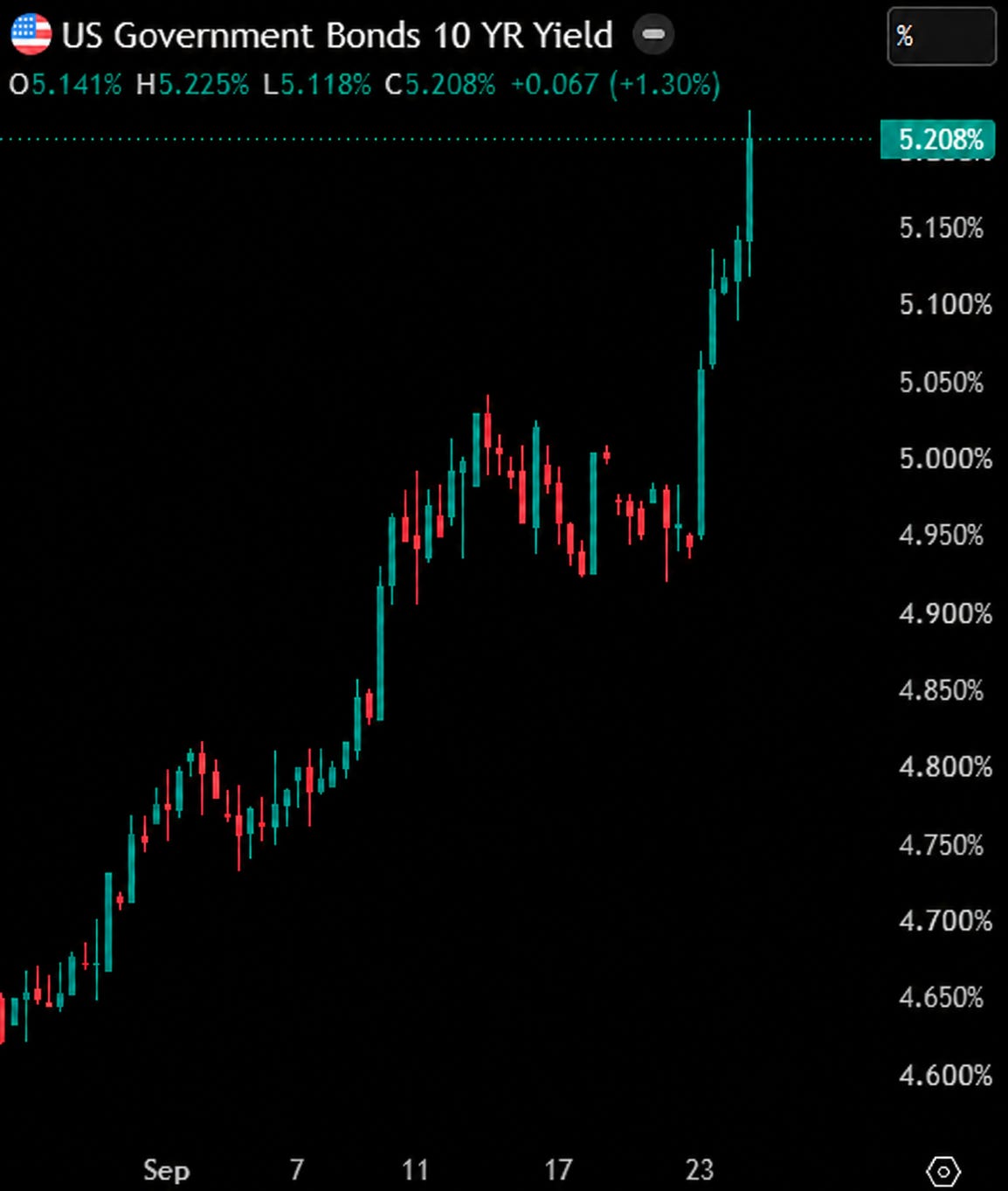
Nineteen years is a number worth pausing on. The last time the 10-year traded this high was the summer of 2007, when it topped out around 5.3 percent in June. On August 9th, less than two months later, BNP Paribas froze three funds because it could no longer value the American mortgage securities inside them, and the credit crisis had its opening bell. On October 9th, the S&P 500 set a high it wouldn’t see again until 2013. History doesn’t promise a repeat. It does suggest that when money gets this expensive, the damage arrives in weeks, and the stock market is often the last to hear about it.
I spend my days around business owners and the banks that lend to them, and my evenings in a classroom full of students who will graduate into whatever this becomes. The obvious question is how high yields could go. The better one is what happens if the market underneath them stops doing its job.
The House Always Wins
On September 9th, Treasury Secretary Scott Bessent stood up at Southern Methodist University and dared the currency market to bet against him. “I am the house now,” he said, explaining that when Washington intervenes in the yen, he has “pretty good insight” into what Tokyo will do. “And you can bet against me if you want.”
On the yen, he had a point. The coordinated buying worked, and the currency climbed to a nearly seven-month high. Two days later the bond market gave its answer. Yields jumped across the 10-, 20-, and 30-year, the 10-year hit 4.93 percent, and an increase in Treasury buybacks to as much as $6 billion per operation did nothing to stop it. Since then the 10-year has climbed nearly thirty basis points more, and the country whose moves he claimed he could read is watching its own bond yields hit thirty-year highs.
The Greeks had a word for what comes after hubris. They called it nemesis, and it rarely arrived from the direction the proud man was watching.
Nassim Taleb tells a story in The Black Swan about a Las Vegas casino that spent a fortune modeling its gambling risk. Its worst losses came from somewhere else entirely: a tiger that mauled one of the stars of its signature show, a contractor who tried to dynamite the building, the kidnapping of the owner’s daughter, and an employee who stuffed years of required tax filings in a drawer. The house had mastered the game it was playing. The danger lived outside the game.
That’s the trouble with thinking you’re the house in a $32 trillion market. A casino wins because customers have to play by its rules. The Treasury has to come back every single week and ask strangers to lend it money at a price they choose. The buyers set the odds in that room, and on Thursday they reminded everyone.
Expensive Money and Broken Plumbing
A 5.2 percent ten-year with functioning auctions is expensive money. The economy can live with expensive money for a long time; it did for most of the 1990s. What it can’t survive for more than a few days is a broken Treasury market, because every other rate in the country, from your mortgage to your bank’s cost of funding, is priced off that curve.
An implosion means the plumbing fails. We got a preview in March 2020, during the “dash for cash,” when everyone on earth tried to sell Treasuries at once and the Fed had to buy more than a trillion dollars of government debt in a matter of weeks to keep the market open. That’s the scenario worth understanding. It sits outside the base case this week, but it’s what a real break would look like, and the conditions for one are closer than they’ve been in years.
The sequence is mechanical, and it tends to unfold within seventy-two hours. A long-bond auction tails badly, clearing well above where the Street expected, or fails to clear at a price anyone will accept. Primary dealers, the big banks obligated to bid at auctions, hit their balance-sheet limits, widen their quotes, and then stop bidding for size. Hedge funds running the basis trade, a bet made with heavily borrowed money on tiny price gaps between Treasury futures and the bonds themselves, get margin calls and dump cash Treasuries. Foreign holders sell to raise dollars or defend their own currencies. Mutual funds and money-market funds face redemptions and sell the one asset that’s supposed to be liquid. Repo rates spike, and collateral that was risk-free on Monday needs a haircut on Wednesday. Credit spreads blow out at the same time, across corporate bonds, municipal debt, and mortgage securities.
Yields stop drifting. They gap. A functioning 5.2 percent ten-year becomes a 6 to 6.5 percent ten-year in days. Mortgage rates head toward 8 percent. Everything else follows from there.
Japan is where the foreign-seller step stops being theoretical. It holds more Treasuries than any other country outside the United States, roughly a trillion dollars, and for two decades its pension funds and insurers bought them because bonds at home paid close to nothing. That excuse is gone. This week Japan’s 2-year and 5-year yields hit 31-year highs, and its 10-year reached 3.06 percent, the highest since 1996, in one of the most indebted economies on earth. Some of that is deliberate, since the Bank of Japan has been raising rates on purpose. The effect is the same either way. When a Japanese insurer can earn a real return in yen without taking currency risk, the marginal buyer of American debt starts heading home. The two largest government bond markets in the world are repricing at the same time.
How It Reaches the Real Economy
Housing freezes first. Thirty-year mortgages are already around 7.5 percent, and in a break they’d reprice toward 8 percent or higher almost overnight. Purchases and new construction stall. The 2008 comparison misleads here, because most current owners are sitting on 3 to 6 percent mortgages they’ll never give up. The damage lands on new activity and on anyone who has to sell.
Corporate America hits a refinancing wall. Investment-grade companies can still borrow, just at much higher coupons. High-yield issuers and private credit borrowers mostly can’t. Floating-rate commercial real estate and leveraged loans turn their maturity wall into a default wall. Capital spending and hiring freeze. The AI data-center boom, which has been one of the biggest sources of demand for power, chips, and construction, gets repriced or pushed back.
Then the government’s own math starts feeding the fire. On a debt stock approaching $40 trillion, every hundred basis points of higher rates eventually costs hundreds of billions of dollars a year in interest. Borrowing into a broken market means higher yields, which means more borrowing, and that loop turns a liquidity event into a fiscal one. Buybacks of a few billion dollars don’t register at that scale. The only buyer big enough is the Fed.
The dollar is the wild card. In 2020 it rallied as the world scrambled for cash. If this break is fiscal, with investors rejecting American paper, the dollar can fall while yields rise. That’s the emerging-market pattern, and it imports more inflation just as the Fed is already worried about energy.
The last people to feel it are the ones with paychecks and fixed-rate mortgages. That’s why the average American has no idea at 5.2 percent. It wouldn’t stay that way at 6.5 percent with a credit crunch on top. Layoffs, higher credit card rates, and a dead housing market show up in household budgets within months.
The Regional Banks Are the Transmission Belt
Big banks and regional banks would live through this very differently. JPMorgan, Bank of America, Citi, and Wells Fargo have diversified funding, enormous deposit bases, access to every Fed facility, and commercial real estate books that are large in dollars but small relative to their capital. They’d lose money on securities and trading. They wouldn’t fail. They’d buy the pieces.
Regionals get hit from four directions at once, and it looks a lot like the Silicon Valley Bank template, updated for 2026.
The first is securities losses. Regional banks still hold big books of Treasuries and mortgage bonds bought when yields were far lower. The ones classified as available-for-sale get marked to market, so book equity falls right away, but most regional and community banks opted out of counting those marks in regulatory capital, so their ratios can look fine while tangible book value gets crushed. The ones classified as held-to-maturity stay hidden at cost until the bank needs cash. Then it has to sell, the accounting fiction breaks, and the whole loss lands in one quarter. That’s exactly what killed SVB. Another 75 to 150 basis points on long rates would tear open the hole everybody papered over.
The second is deposits. In a Treasury panic, uninsured depositors don’t wait for a press release. SVB customers pulled $42 billion in a single day in March 2023. Money moves to the megabanks, money-market funds, and T-bills, and the regionals that keep their deposits pay far more to do it. The Bank Term Funding Program that stopped the bleeding in 2023 expired in 2024. The discount window and Federal Home Loan Bank advances still exist, but a regional that leans on them in week one becomes a headline in week two.
The third is commercial real estate, and it’s worse than 2023. Roughly a third of America’s commercial mortgage dollars, on the order of $1.6 trillion, sits on regional balance sheets, and plenty of those banks carry CRE at 300 percent or more of their core capital. Higher Treasury yields push cap rates up and property values down, so loans that look current because they were quietly extended become undercollateralized. Floating-rate and maturing loans can’t roll at a 5.2 percent ten-year plus a spread, let alone 6.5. Owners hand back the keys. Banks can extend and pretend for a while. In a funding panic, they can’t. Office is the worst pocket, and multifamily is the bigger one.
The fourth is capital, and it’s where the first three meet. Securities losses, deposit flight, and CRE charge-offs eat the cushion from three sides, and then regulators, or the market, force the bank to stop lending.
That last step is the one that matters most for Main Street. Small businesses, local developers, and rural housing don’t borrow from JPMorgan. They borrow from the bank down the street, and when that bank is defending its own balance sheet, their credit disappears even if the megabanks are perfectly fine. Not every regional would break, but contagion doesn’t need many. In 2023, three or four names repriced the entire sector in a matter of days. The KBW regional bank index is already down about 6 percent in a month on this move in yields, with no implosion. In the implosion case it doesn’t drift either. It gaps.
What Washington Would Do
Washington wouldn’t watch this happen, and the playbook is well known. The Fed would buy Treasuries in size, lean on its standing repo facility, and probably revive something like the 2023 program so banks could borrow against their bonds at face value instead of selling them. Treasury would shrink or cancel long-dated auctions and shift to bills. The FDIC would invoke its systemic-risk exception if a mid-size regional were about to go under.
The Fed can still do all of that, despite enormous unrealized losses on its own portfolio. The real constraint is politics. Buying bonds while inflation climbs and oil stays expensive means printing money into an inflation problem, which is why a break at 5 percent yields would be far nastier than March 2020, when inflation was the least of anyone’s worries.
What I’d Do Now
Panic won’t help. Preparation, while the plumbing still works, will.
Lock in what you can. If you have debt coming due in the next eighteen months, start the refinancing conversation now, while lenders are still lending and markets are still open. Extend lines of credit before you need them. Nobody gets good terms in the middle of a funding panic.
Know your bank. Ask how concentrated it is in commercial real estate and how much of its deposit base is uninsured. If you keep more than the insured limit in one place, look at insured sweep programs or spread the money across institutions.
Plan at today’s rates. Stop assuming rates come back down next year. Build your budget, your pricing, and your hiring plan around a 5 percent ten-year and treat anything lower as a gift.
Keep more cash than feels efficient. Cash buys time, and time lets you decide on your own schedule instead of your lender’s.
Watch the plumbing along with the price. Long-bond auction results, overnight repo rates, the spread between newer and older Treasuries, and the regional bank index will tell you whether this is expensive money or something worse. A 10-year at 5.3 percent with clean auctions is uncomfortable. A 10-year at 5.3 percent with a tailed auction and a repo spike is a warning.
Before It Feels Real
Every financial crisis I’ve studied has the same odd feature. The people inside it could see the numbers, but they couldn’t feel them yet, and by the time they felt them the choices had narrowed. The bond market is telling us something right now in the only language it has. Some of the most powerful people in Washington have decided they can talk over it.
I’d rather listen. The market isn’t broken today, and there’s still time to prepare as if it could be. The average American has no idea this is happening.
The ones who read the signal early won’t have to find out the hard way.
P.S. Leading through a crisis era is the subject of my book Honor Under Pressure, and its companion site, thefourthturningleader.com, is built for moments like this one, when the signals are flashing and most people haven’t noticed yet: making sound decisions before you’re forced to, and keeping your people steady when the ground starts to move. Start with the free Mode Finder assessment, which shows you how you tend to lead under pressure, and then work through the practical tools behind it.