


Less than a week ago (April 7, 2026), the world exhaled. The ceasefire was announced with less than two hours to spare, and by Wednesday morning the consensus had shifted from dread to something that felt, for a moment, like relief. Markets moved higher. Headlines reached for the word “de-escalation.” For about thirty-six hours, it was possible to believe the worst was behind us.
I want to tell you why that exhale worries me more than the crisis that preceded it.
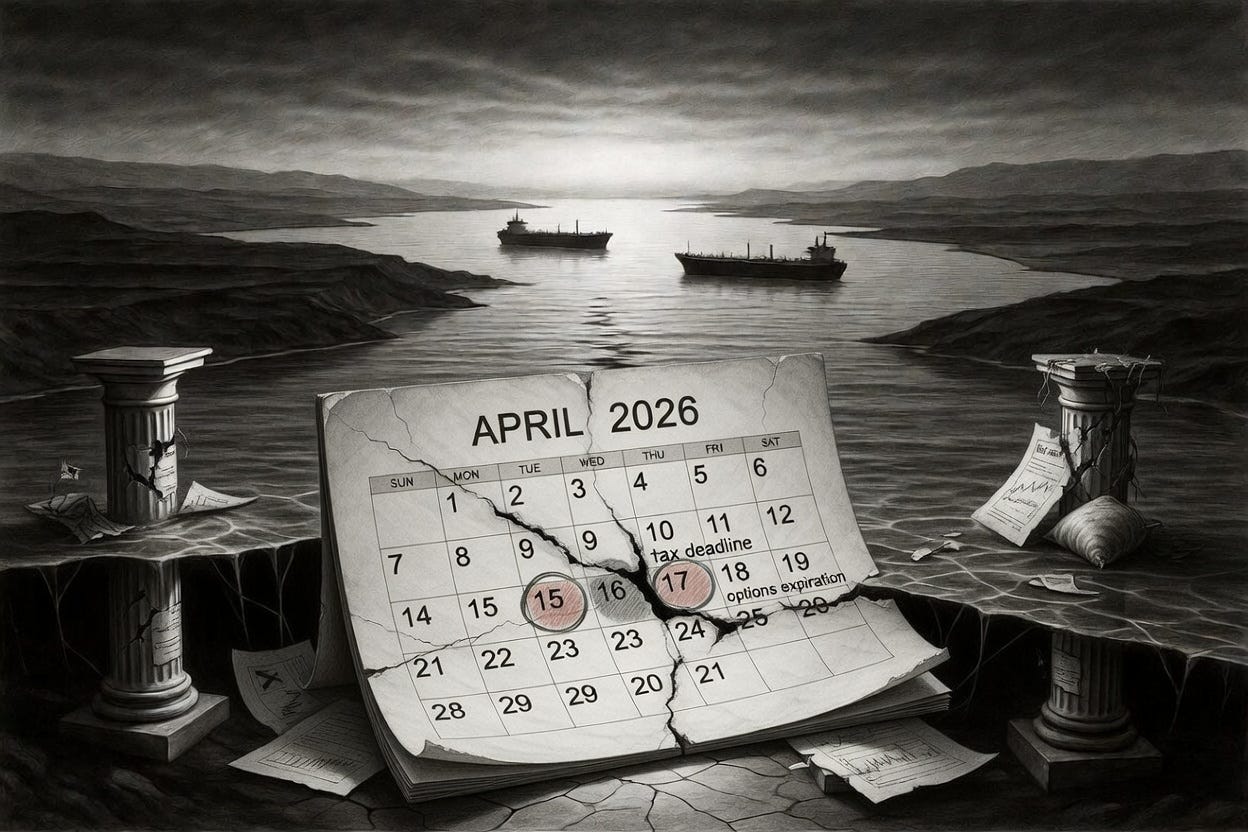
There is a particular kind of structural danger that does not arrive during the visible crisis. It arrives in the pause immediately after. The threat appears to recede. The positioning shifts from defensive to opportunistic. Vigilance relaxes. And in that precise window, the systems that were supposed to absorb the next shock are at their most exposed, because everyone just decided they were no longer needed.
That is the moment we are in right now.
The Bet We Already Named
A few weeks ago, in “The Forty-Mile Hostage Crisis,” I wrote that we had placed a civilizational wager on forty miles of open water. Twenty million barrels a day. Nearly a third of globally traded fertilizers. The world’s most consequential chokepoint, treated for half a century as though it were simply there, like gravity, because it had always been.
That bet is now being called, and the terms are worse than what I described.
The ceasefire announced April 8 fractured almost immediately. Israel struck Hezbollah positions in Lebanon within hours of the announcement. Iran’s Revolutionary Guard declared the Strait effectively closed again. Both sides accused the other of bad faith before the terms were even distributed. The talks now (allegedly) underway in Islamabad, with the U.S. and Iranian delegations seated across a table at the Serena Hotel, are not a resolution mechanism. Pakistan’s stated goal is simply to keep the conversations going. That phrase tells you everything about the expected trajectory. When your diplomatic objective is continuity rather than outcome, you are managing a timeline, not solving a problem.
Here is the detail that matters most: as of April 9, Strait of Hormuz traffic remains at less than ten percent of normal volumes. Vessels are still loitering off Qeshm Island for security checks or payments. The infrastructure damage to port facilities and Qeshm-related assets ensures that even a best-case diplomatic result does not restore flows for six to eight weeks. The ceasefire exists on paper. The chokepoint remains effectively closed. Those are not the same thing, and markets spent thirty-six hours trading as though they were.
The Architecture of Simultaneous Failure
What I want to describe here is not a single crisis. It is something more specific and, in some ways, more dangerous: simultaneous buffer failure. What happens when multiple systems lose their margins of safety in the same window. Each buffer, on its own, might absorb a shock. When they all thin out together, there is nothing underneath.
There are four of them converging right now.
The geopolitical buffer was the ceasefire. And a ceasefire that depends on mutual trust between parties who have demonstrated, repeatedly, that they have none, is not a buffer. It is a countdown dressed up as a resolution. The Islamabad talks are not a pressure release. They are the moment where the market discovers whether the buffer was real or performative. The early evidence is not encouraging.
The market structure buffer is subtler, but it follows the same logic. Markets rallied hard into the ceasefire announcement. The buying was confident, positioned aggressively for de-escalation. But confident buying into a single thesis creates its own fragility: when everyone is leaning the same direction, the order book thins out on the other side. There is no one left to absorb the selling if the thesis breaks. You do not need to understand options mechanics to grasp this. The concept is universal: a market that has priced in good news has already spent its optimism. What remains is the gap between expectation and reality. Gaps in load-bearing structures tend to close violently. Regular readers of these pages lived through the Liberation Day tariff shock last spring. Strong open, intraday reversal, and then a three-day cascade exceeding ten percent. The architecture was identical: consensus positioning, a single catalyst, and then the floor. The pattern is not new. Andrew Ross Sorkin’s work on 1929 traces the same sequence, a parabolic top running into thin liquidity, with concentration in a handful of names masking the fragility underneath.
The calendar buffer is the one no one is talking about. April 15 is the federal tax deadline, and April 17 is monthly options expiration. These are not dramatic events. They are mechanical. Cash leaves the system on the 15th. The structural guardrails that have been compressing volatility roll off on the 17th. In a normal week, these are manageable. In a week where the geopolitical buffer is already fracturing and the market structure buffer is already thin, the calendar removes the last layer of cushion. The calendar does not care about the negotiations in Islamabad. April 15 arrives whether or not the Strait of Hormuz reopens. And when cash leaves the system on a deadline that cannot be moved, whatever fragility exists in the structure is revealed.
The supply chain buffer is the one with the longest lag and the most certain consequences. I wrote about this in last week. The damage is already done. Fertilizer prices are up thirty to forty percent. Plants are idling in India, Algeria, and Slovakia. China has restricted fertilizer exports. Farmers across Australia, the United States, and Asia are planting less or facing margin squeezes severe enough to alter their decisions for the entire growing season. Diesel futures were up sixty-nine percent in the early conflict phases. Even if the Islamabad talks produce a genuine agreement this weekend, the supply chain does not reset on that timeline. Normalization takes six to eight weeks at minimum. The food-price shock is already baked into Q3 2026. The disruption to global fertilizer and energy supply is not a risk. It is a fact. It is already absent from the soil. The planting decisions being made right now, under these input costs, will determine food prices six months from now regardless of what happens at the Serena Hotel.
What It Looks Like When the Floor Disappears
The point is not that any single pillar causes a crisis. The point is that all four are arriving in the same seven-day window, and each one removes a layer of protection that the others depend on.
I am not making a market prediction. What I am describing is what it looks like when every buffer thins out at the same time, because that is something I have seen before, in markets, in organizations, and in the historical record. The pattern is consistent. When the cushions are removed simultaneously, the correction is faster and deeper than anyone positioned for continuation expects. The people paying attention to structure rather than headlines will see it. The people trading on the ceasefire headline will discover it.
I’ve written extensively about systems designed for problems that no longer exist. Every diplomatic framework being deployed right now was built for a different era of U.S.-Iran relations. Every market structure model was calibrated for conditions that no longer obtain. The architecture is being stress-tested by circumstances it was not designed to absorb. That is not a political observation. It is an engineering one.
What This Means on the Ground
I see this from a few vantage points, and they point in the same direction.
For business owners and operators: the time to stress-test your cash position is this weekend, not next month. If your margins depend on stable input costs, model a scenario where diesel remains elevated through Q3. If you carry inventory with Strait-dependent inputs, whether energy, fertilizers, or petrochemicals, examine that exposure now. The leaders who built thirty-day buffers after “The Forty-Mile Hostage Crisis” are in a materially different position than those who waited to see how the talks went. The gap between them is not intelligence. It is the discipline to act before the pressure is undeniable.
For investors and anyone with market exposure: the “crisis averted” narrative is itself a risk factor right now. When positioning is uniformly optimistic and the structural supports are thinning, the cost of caution is low and the cost of complacency is potentially severe. Nassim Taleb’s concept of the fragilista, the person who mistakes the absence of visible risk for the absence of actual risk, is precisely what this moment is manufacturing at scale. This is not a call to liquidate everything. It is a call to understand what you own, understand why you own it, and ask honestly whether your thesis accounts for four buffers failing simultaneously. If it does not, that is worth knowing before April 17.
For students and emerging leaders: What this week is teaching, if you are paying attention, is a skill that no curriculum covers: how to read structure instead of headlines. Every signal available to the public this week said "relief." The ceasefire was announced. Markets moved higher. The word de-escalation appeared in every feed. And underneath all of it, four load-bearing systems were simultaneously losing their margins of safety. The headline and the structure were pointing in opposite directions. Most people followed the headline. That gap, between what the surface says and what the architecture is doing, is where careers are made and portfolios are destroyed. Learning to see it now, before you have significant capital or significant responsibility on the line, is one of the more valuable things this moment has to offer. The tuition is high. Use it.
The collective exhale on the night of the 7th was understandable. After weeks of watching the Strait close and the headlines darken, the word “ceasefire” felt like oxygen. I felt it too. There is nothing cynical about relief.
But relief and safety are not the same thing. And the distinction between them, in this particular week, in this particular structural configuration, is precisely the kind of thing that serious leaders need to hold clearly in their minds, even when the headlines are pulling them toward relaxation.
I have been writing about these pressures, individually and together, for several years now. The geopolitical fragility. The market structure. The supply chain damage that accrues silently until it suddenly isn’t silent anymore. The calendar mechanics that no negotiation can move. They were risks then. They are facts now.
The people who hold through what is coming will not be the ones who predicted it most precisely. They will be the ones who built something to hold with before the floor disappeared.
Honor Under Pressure is available now. The full series, along with ongoing resources and community for leaders navigating the Fourth Turning, lives at www.thefourthturningleader.com.